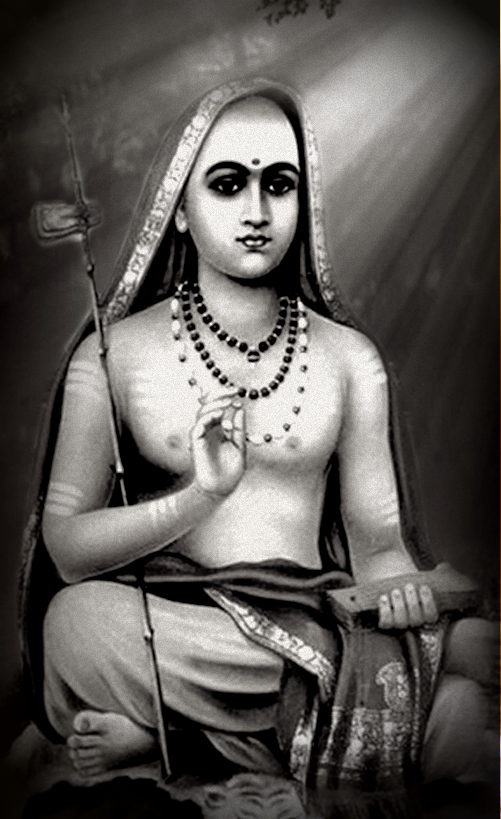
Bhaja Govindam
Bhaja Govindam was rendered extempore by Jagadguru Sri Adi Sankaracharya.
The story behind this great work is this. Sri Adi Sankaracharya came across an old grammarian who was strenuously memorizing all the complex rules of Grammar, instead of devoting his time in contemplating on God and meditating. Due to Sri Sankara’s compassion and kindness, then and there emerged this flow of beautiful but profound poetry from Him to lead the devotee in the right path.
Sri Ramana Maharshi tells his devotees that Abhyasa and Vairagya (Practice and Dispassion) are both important for spiritual advancement and self-improvement. Bhaja Govindam offers ample guidance in both these areas.
The English translations for the Verses provided here were rendered by Sri Swami Chinmayananda in his commentary on Bhaja Govindam. I have benefited very much from Swami Chinmayananda’s Works.
Bhaja Govindam is one of the minor compositions of Sri Sankara. It is classified as a a primer to the major Works. However, the depth of wisdom and practical advice offered in this great work is of immense value and help to any sincere spiritual seeker. Also sung as a Bhajan (devotional song), this poetic garland strewn with pearls of knowledge contains the essence of Vedanta. It implores a person to think about a higher goal in life, of lasting happiness. It reveals the hollowness of mere pleasure seeking, the misery of disease and old age and the typical selfish nature of people. It provokes wise thinking and asks men and women to enquire about important questions such as “Who am I ? Why am I here in this life ? Why am I acquiring wealth, family, fame, power etc., but end up not having any enduring peace of mind ? What is the Truth ? What is the purpose of life ?”
When one reads Bhaja Govindam, it may seem dismal, bleak, cheerless and gloomy for some. But it is not meant to depress anyone. It is meant to make people gradually understand the downside of over-indulging in things of the world, while stressing the importance of attaining Self-Realization. So if one continues to read Bhaja Govindam with this attitude and ponder over it, they may not even have to do anything; wisdom will dawn by itself; the disadvantageous qualities wil just drop off by themselves. Sri Ramana Maharshi said that even if one does not understand a scripture, they should still read it; it will have its beneficial effect on the reader.
A surgeon may appear ruthless when he performs a surgery on a patient, but he does so only to save the patient and offer him a better life. Similarly, great spiritual Scriptures and Sages never compromise from telling the Truth. They say it like they see it, sometimes bluntly and directly, in order to wake up one who is slumbering in ignorance.
It is said that Sri Sankara burst forth with the first 12 stanzas of Bhaja Govindam. Thus the garland of stanzas 1-12 are called dvadasa manjarika stotram. Inspired by the extempore recital by Sankara, each of his 14 disciples composed a verse, and the 14 verse garland is called chaturdasa manjarika stotram. Sankara added the finishing touches by adding five of his own stanzas at the end bringing the total to 31. The 32nd verse is just a concluding verse.
The stanzas may be arranged or classified differently from other sources of Bhaja Govindam you might have seen. The order really does not matter. Each verse stands on its own and is helpful on its own. To read these verses and to contemplate on them is Satsang, getting in touch with God, the Real Self of the nature of Being-Consciousness-Bliss. It is really very simple. If we keep thinking about a Dog, we get a Dog. If we keep thinking about God, we get God. The option is ours.
Below is the song of “Bhajan Govindam”, the musical version of the verses.
If you like, you can listen to the song while looking at the lyrics.
Bhaja Govindam – Song
Sung By: Vasundhara
Verse 1
Bhaja Govindam, Bhaja Govindam,
Govindam Bhaja mooDha mate;
Sampraapte sannihite kaale
Nahi nahi rakshati Dukrunghkarane. – 1
भजगोविन्दं भजगोविन्दं
गोविन्दं भजमूढमते ।
सम्प्राप्ते सन्निहिते काले
नहि नहि रक्षति डुकृञ्करणे ॥ १॥
Worship God, Worship God,
Worship God, Oh deluded one.
When death, the appointed end of lifetime comes
Grammar rules will not save you. – 1
Verse 2
MooDha jaheehi danaagama trishnaam
Kurusadbuddhim manasi vitrishnaam;
Yallabhase nija karmopaattham
Vittham tena vinodaya chittham. – 2
मूढ जहीहि धनागमतृष्णां
कुरु सद्बुद्धिं मनसि वितृष्णाम् ।
यल्लभसे निजकर्मोपात्तं
वित्तं तेन विनोदय चित्तम् ॥ २॥
Oh deluded one ! Give up the thirst to possess wealth.
Create in your mind thoughts of the Reality, devoid of passions.
With whatever you obtained as results from your past actions,
entertain your mind and be content. – 2
Verse 3
Naaree sthanabhara naabi desam
Dristva maaga mohaavesam;
Yetan maamsaa vasaadi vikaaram
Manasivi chintaya vaaram vaaram. – 3
नारीस्तनभर नाभीदेशं
दृष्ट्वा मागामोहावेशम् ।
एतन्मांसवसादि विकारं
मनसि विचिन्तय वारं वारम् ॥ ३॥
Seeing a woman’s navel and chest, do not get carried away
by the storm of desires. These are only modifications of flesh.
Think well thus in your mind again and again. – 3
Verse 4
Nalinee dalagata jalamati taralam
Tadwajjeevitam atisaya chapalam;
Viddhi vyaadhyabhimaana grastam
Lokam sokahatam cha samastam. – 4
नलिनीदलगत जलमतितरलं
तद्वज्जीवितमतिशयचपलम् ।
विद्धि व्याध्यभिमानग्रस्तं
लोकं शोकहतं च समस्तम् ॥ ४॥
Just as a drop of water on a lotus leaf
has an extremely uncertain existence,
so also life is strange and uncertain.
Know that the whole perceived world is consumed
by disease, conceit (ego) and grief. – 4
Verse 5
Yavadvittho paarjana sakta
Staavannija parivaaro raktaha;
Paschaat jeevathi jarjara dehe,
Vaartaam kopina prichchati gehe – 5
यावद्वित्तोपार्जन सक्त-
स्तावन्निज परिवारो रक्तः ।
पश्चाज्जीवति जर्जर देहे
वार्तां कोऽपि न पृच्छति गेहे ॥ ५॥
As long as there is the ability to earn and save,
so long all your dependents (family, relatives and friends)
are attached to you. Later on when you come to live
with an old infirm body, no one at home
cares to speak even a word with you. – 5.
Verse 6
yaavatpavano nivasati dehe
taavath prichchati kushalam gehe
gatavati vaayou dehaapaye
bharya bibhyati tasmin kaaye. – 6
यावत्पवनो निवसति देहे
तावत्पृच्छति कुशलं गेहे ।
गतवति वायौ देहापाये
भार्या बिभ्यति तस्मिन्काये ॥ ६॥
As long as there dwells life-breath in the body,
so long they enquire of your welfare at home.
Once the life-breath leaves, the body decays,
and even his wife fears the very same body. – 6
Verse 7
Baalastavat kreedasaktaha
tarunastavah tarunee saktaha;
Vruddha staavat chinta sakthaha
Parase brahmani kopi na sakthaha. – 7
बालस्तावत्क्रीडासक्तः
तरुणस्तावत्तरुणीसक्तः ।
वृद्धस्तावच्चिन्तासक्तः
परमे ब्रह्मणि कोऽपि न सक्तः ॥ ७॥
In one’s Childhood, one is attached to playing.
In one’s Youth, one is attached to one’s young woman.
In one’s Old age, one is attached to anxieties.
But there is no one who wants to be attached to Supreme Brahman (Almighty Self). – 7
Verse 8
Kaa te kantaa kaste putraha
Samsaaroya mateeva vichitraha;
Kasya twam ka kuta aayataha
Tattvam chintaya tadiha bhraataha. – 8
काते कान्ता कस्ते पुत्रः
संसारोऽयमतीव विचित्रः ।
कस्य त्वं कः कुत आयातः
तत्त्वं चिन्तय तदिह भ्रातः ॥ ८॥
Who is your wife ? Who is your son ?
Supremely wonderful is this Samsara*.
Of whom are you ? From where have you come ?
Ponder over this truth here, Oh Brother. – 8
* Pronounced Samsaara : (the perceived empirical world)
Verse 9
Satsangatve nissangatvam
Nissangatve nirmohatvam;
Nirmohatve nischala tatvam,
Nischala tatve jeevan muktihi. – 9
सत्सङ्गत्वे निस्सङ्गत्वं
निस्सङ्गत्वे निर्मोहत्वम् ।
निर्मोहत्वे निश्चलतत्त्वं
निश्चलतत्त्वे जीवन्मुक्तिः ॥ ९॥
From association with the Wise comes non-attachment.
From non-attachment comes freedom from delusion.
Through freedom from delusion comes abiding in the Self, the Immutable Reality.
From abiding in the Self comes the state of “Liberated in Life”. – 9
Verse 10
Vayasi gate ka kaama vikaaraha
Shushke neere ka kaasaaraha;
Kshine Vitte ka parivaaraha
Gnate tatve ka samsaaraha. – 10
वयसिगते कः कामविकारः
शुष्के नीरे कः कासारः ।
क्षीणेवित्ते कः परिवारः
ज्ञाते तत्त्वे कः संसारः ॥ १०॥
Where is passion when Youth has passed ?
Where is the lake when there is no water ?
Where are the relatives and retinue when wealth has diminished ?
Where is Samsara* when the Truth is realized ? – 10
* Pronounced Samsaara : (the perceived world of delusion)
Verse 11
Maa kuru dana jana youvana garvam
Harati nimeshaath kaalaha sarvam;
Maayamaya midamakilam hitwa
Brahmapadam tvam pravisa viditva. – 11
मा कुरु धन जन यौवन गर्वं
हरति निमेषात्कालः सर्वम् ।
मायामयमिदमखिलं हित्वा var बुध्वा
ब्रह्मपदं त्वं प्रविश विदित्वा ॥ ११॥
Do not get conceited of your wealth, your people and your youth.
Time destroys each one of these in a minute.
Knowing their illusory nature, leaving all these aside,
Realize the State of Brahman (Timeless Reality) and enter into it. – 11
Verse 12
Dinayaaminyou, saayam praataha
Sisira vasanthou punaraayatah;
Kala kreedati gachat yaayuhu
Tadapi na munjathyaasa vayuhu. – 12
दिनयामिन्यौ सायं प्रातः
शिशिरवसन्तौ पुनरायातः ।
कालः क्रीडति गच्छत्यायुः
तदपि न मुञ्चत्याशावायुः ॥ १२॥
Day and night, dusk and dawn,
Winter and spring come and go again and again.
Time sports with Life and Life ebbs away.
But one does not leave the storms of desires. – 12
Note:
द्वादशमञ्जरिकाभिरशेषः
कथितो वैयाकरणस्यैषः ।
उपदेशो भूद्विद्यानिपुणैः
श्रीमच्छन्करभगवच्छरणैः ॥ १२अ ॥
This bouquet of twelve verses was imparted to a grammarian
by the all-knowing Sri Adi Sankara, adored as the Bhagavadpada.
Verse 13
Kaate kantaa dhana gata chintaa
Vaatula kim tava naasti niyantaa
Trijagati sajjana sam gatiraikaa
Bhavati BhavaarNava taraNe noukaa. – 13
काते कान्ता धन गतचिन्ता
वातुल किं तव नास्ति नियन्ता ।
त्रिजगति सज्जनसं गतिरैका
भवति भवार्णवतरणे नौका ॥ १३॥
Oh Distracted one! Why worry about wife, wealth etc. ?
Is there not for you the One who ordains?
In the three worlds, the “association with wise people” alone
can serve as a boat to cross the sea of change (birth and death). – 13
Above Stanza attributed to Sri Padmapada.
Verse 14
Jatilo mundee lunchita kesaha
Kaashayaambara bahu kruta veshaha;
Pasyannapi cha na pasyati moodhaha
Udara nimithttam bahu kruta veshaha. – 14
जटिलो मुण्डी लुञ्छितकेशः
काषायाम्बरबहुकृतवेषः ।
पश्यन्नपि चन पश्यति मूढः
उदरनिमित्तं बहुकृतवेषः ॥ १४॥
One ascetic with matted locks, one with a shaven head,
one with hairs pulled out one by one, another parading
in ochre robes – these are fools who, though seeing, do not see.
Indeed these different disguises or apparels are only
for the sake of their stomach. – 14
Above Stanza attributed to Sri Totakacharya.
Verse 15
Angam galitam palitam mundam,
Dasanaviheenam jatam tundam,
Vruddho yaati gruheetva dandam,
Tadapi na munjatyaasa pindam. – 15
अङ्गं गलितं पलितं मुण्डं
दशनविहीनं जातं तुण्डम् ।
वृद्धो याति गृहीत्वा दण्डं
तदपि न मुञ्चत्याशापिण्डम् ॥ १५॥
The body has become worn out. The head has turned grey.
The mouth has become toothless. The old man moves about
leaning on his staff. Even then he does not leave the bundle of his desires. – 15
Above Stanza attributed to Sri Hastamalaka.
Verse 16
Agre Vahni, prashte bhanu,
Rathrou chibuka samarpita janu,
Karatala biksha taru tala vasa
tadapi na munjatyasapasa. – 16
अग्रे वह्निः पृष्ठेभानुः
रात्रौ चुबुकसमर्पितजानुः ।
करतलभिक्षस्तरुतलवासः
तदपि न मुञ्चत्याशापाशः ॥ १६॥
In front the fire, at the back the Sun,
late at night he sits with his knees held to his chin.
He receives alms in this own scooped palm of the hand
and lives under the shelter of some tree.
And yet, the noose
of his desires does not spare him. – 16.
Above Stanza attributed to Sri Subodha.
Verse 17
Kurute Ganga saagara gamanam,
Vruta paripaalana mathava dhaanam,
Gnana viheena sarva matena,
Muktim na bhajati janma satena. – 17
कुरुते गङ्गासागरगमनं
व्रतपरिपालनमथवा दानम् ।
ज्ञानविहीनः सर्वमतेन
मुक्तिं न भजति जन्मशतेन ॥ १७॥
One may in pilgrimage go to where the Ganges
meets the ocean called the Gangasagar. Or observe vows.
Or distribute gifts away in charity. But if he is devoid of
first hand experience of Truth-Knowlege (Jnanam),
according to all schools of thought, he gains no Liberation
(Self-Realization), even in hundred lives.
Above Stanza attributed to Sri Vartikakara aka Sureshwaracharya.
Verse 18
Sura mandira taru moola nivaasaha,
Sayya bhootala majinam vaasaha,
Sarvaparigriha bhoga tyaagaha,
Kasya sukham na karoti viraagaha. – 18
सुर मन्दिर तरु मूल निवासः
शय्या भूतल मजिनं वासः ।
सर्व परिग्रह भोग त्यागः
कस्य सुखं न करोति विरागः ॥ १८॥
Dwelling in temples, under some tree, sleeping on the bare ground,
wearing a cloth, and thus renouncing all ideas of possession
and thirst to enjoy, to whom will not dispassion bring happiness ? – 18
Above Stanza attributed to Sri Nityananda.
Verse 19
Yoga rato vaa bhogarato vaa,
Sanga rato vaa sanga viheenaha,
Yasya brahmani ramate chittam,
Nandati nandati nandatyeva. – 19
योगरतो वाभोगरतोवा
सङ्गरतो वा सङ्गविहीनः ।
यस्य ब्रह्मणि रमते चित्तं
नन्दति नन्दति नन्दत्येव ॥ १९॥
Let one revel in Yoga (mental contact with the Self),
or let him revel in Bhoga (enjoyment).
Let one seek enjoyment in company, or let him revel
in solitude away from the crowd. He whose mind revels in Brahman (Supreme Reality),
He enjoys… He enjoys… indeed He alone enjoys. – 19
Above Stanza attributed to Sri Anandagiri.
Verse 20
Bhagavad geeta kinchidadheetaa,
Gangaajalalava kaNikaa peeta,
Sukrudapi yena muraari samarchaa,
Kriyate tasya yamena na charchaa. – 20
भगवद् गीता किञ्चिदधीता
गङ्गा जललव कणिकापीता ।
सकृदपि येन मुरारि समर्चा
क्रियते तस्य यमेन न चर्चा ॥ २०॥
To one who has studied the Bhagavad Gita even a little,
he who has sipped at least a drop of Ganges-water,
he who has worshipped at least once the Lord Murari
to him there is no dispute with Yama (Lord of Death). – 20
Note : Lord Murari : (Sri Krishna, the destroyer of the demon Mura)
Above Stanza attributed to Sri Dridhabhakta.
Verse 21
Punarapi jananam punarapi maraNam,
Punarapi jananee jathare sayanam,
Iha samsaare bahu dustaare,
Krupayaa paare paahi Muraare. – 21
पुनरपि जननं पुनरपि मरणं
पुनरपि जननी जठरे शयनम् ।
इह संसारे बहुदुस्तारे
कृपयाऽपारे पाहि मुरारे ॥ २१॥
Again and again one is born, again and again one dies,
Again and again one lies in the mother’s womb.
This Samsar (limitless Sea of Life) is very hard to cross over.
Please save me, Oh Lord Murari,
through Your Infinite Kindness. – 21
Note : Lord Murari : (Sri Krishna, the destroyer of the demon Mura)
Above Stanza attributed to Sri Nitayanatha.
Verse 22
Rathyaa charpata virachita kanthaha,
Punyaapunya vivarjita panthaha,
Yogi yoga niyojita chitto,
Ramate baalonmattava deva. – 22
रथ्या चर्पट विरचित कन्थः
पुण्यापुण्य विवर्जित पन्थः ।
योगी योगनियोजित चित्तो
रमते बालोन्मत्तवदेव ॥ २२॥
The Yogin who wears just a “godadi” shawl, who walks the path
that is beyond merit and demerit, whose mind is joined
in perfect Yoga with its goal, he revels in God-consciousness,
and lives thereafter like a child or like a mad man. – 22
* godhadi: A shawl made up of pieces of cloth rejected by others, picked up from the streets and stitched together.
Above Stanza attributed to Sri Nitayanatha.
Verse 23
Kastwam Koham kuta ayataha?
Kaa me jananee ko me tataha,
Iti paribhaavaya sarvamasaaram,
Viswam tyaktwaa swapna vichaaram. – 23
कस्त्वं कोऽहं कुत आयातः
का मे जननी को मे तातः ।
इति परिभावय सर्वमसारम्
विश्वं त्यक्त्वा स्वप्न विचारम् ॥ २३॥
Who are you ? Who am I ? From where did I come ?
Who is my mother ? Who is my father?
Thus enquire, leaving aside the entire world of experiences,
That are essenceless and a mere dreamland, born of imagination. – 23
Above Stanza attributed to Sri Surendra.
Verse 24
Twayi mayi chaanya traiko vishnuhu,
Vyartham kupyasi mayya sahishnuhu,
Bhava sama chittaha sarvatra twam,
Vaanchasyachiraadyadi Vishnutwam. – 24
त्वयि मयि चान्यत्रैको विष्णुः
व्यर्थं कुप्यसि मय्यसहिष्णुः ।
भव समचित्तः सर्वत्र त्वं
वाञ्छस्यचिराद्यदि विष्णुत्वम् ॥ २४॥
In you and in me and and in all other places too,
there is but one All-Pervading Reality.
Being impatient, you are unnecessarily getting angry with me.
If you want to attain soon the Reality-State,
be equanimous and well-balanced under all circumstances. – 24
Above Stanza attributed to Sri Medhatithira.
Verse 25
Satrou mitre putre bandhou,
Maa kuru yatnam vigraha sandhou,
Sarwasminnapi pasyaatmaanam,
Sarvatrothsyuja bhedaajnanam. – 25
शत्रौ मित्रे पुत्रे बन्धौ
मा कुरु यत्नं विग्रहसन्धौ ।
सर्वस्मिन्नपि पश्यात्मानं
सर्वत्रोत्सृज भेदाज्ञानम् ॥ २५॥
Do not strive or waste your energy to fight against,
or to make friends with your enemy, friend, children or relative.
Seeking the Self everywhere, lift the sense of difference,
the plurality born out of ignorance of the Truth. – 25
Above Stanza attributed to Sri Medhatithira.
Verse 26
Kaamam krodham lobham moham,
Tyaktwaatmaanam bhaavaya koham,
Atma jnana viheenaa moodha,
Te pachyante naraka nigoodha. – 26
कामं क्रोधं लोभं मोहं
त्यक्त्वाऽऽत्मानं भावय कोऽहम्।
आत्मज्ञान विहीना मूढाः
ते पच्यन्ते नरकनिगूढाः ॥ २६॥
Leaving desire, anger, greed and delusion,
the seeker sees in the Self – “He Am I”.
They are fools who do not have Self-Knowledge,
and consequently they are tortured in hell. – 26
Above Stanza attributed to Sri Bharativamsha.
Verse 27
Geyam Gita, Naama sahasram,
Dhyeyam sri pati roopamajasram,
Neyam sajjana sange chittam,
Deyam deenajanaaya cha vittam. – 27
गेयं गीता नाम सहस्रं
ध्येयं श्रीपति रूपमजस्रम् ।
नेयं सज्जन सङ्गे चित्तं
देयं दीनजनाय च वित्तम् ॥ २७॥
Bhagavad Gita and Sahasranama (Thousand Names of God) should be chanted.
Always the form of God should be meditated upon.
The mind should be led towards the company of the wise.
Wealth should be shared with the needy.- 27
Above Stanza attributed to Sri Sumatir.
Verse 28
Sukhata kriyate raamaa bhogaha,
Paschaadanta sarere rogaha,
Yadyapi loke maraNam sharaNam,
Tadapi na munchathi paapaacharaNam. – 28
सुखतः क्रियते रामाभोगः पश्चाद्धन्त शरीरे रोगः ।
यद्यपि लोके मरणं शरणं तदपि न मुञ्चति पापाचरणम् ॥ २८॥
Readily one indulges in carnal pleasures.
Later on, alas, come diseases of the body.
Even though in the world the ultimate end is death,
still the man does not leave his sinful behaviour. – 28
Verse 29
Arthamanartham Bhaavaya nityam,
Naasti tatah sukalesah satyam,
Putraadapi dhana bhaajam bheethihi,
Sarvatraishaa vihitaareetihi. – 29
अर्थमनर्थं भावय नित्यं नास्तिततः सुखलेशः सत्यम् ।
पुत्रादपि धन भाजां भीतिः सर्वत्रैषा विहिता रीतिः ॥ २९॥
“Wealth is meaningless (useless)”, thus contemplate constantly.
The truth is that there is no happiness at all to be obtained from it.
To the rich man, there is fear even from his own son.
This is the way of wealth everywhere.
Verse 30
PraaNaayaamam pratyaahaaram,
Nityaa nitya viveka vichaaram,
Jaapyasameta samadhi vidhaanam,
Kurvavadhaanam mahadava dhaanam. – 30
The control of all activities (of life’s manifestations in you),
the sense withdrawal (from their respective sense-objects),
the reflection (consisting of discrimination between the permanent
and the impermanent), along with Japa (chanting) and practice
of the reaching the Total Inner Silence (Samadhi) –
all these perform with care….with great care. – 30
प्राणायामं प्रत्याहारं
नित्यानित्य विवेकविचारम् ।
जाप्यसमेत समाधिविधानं
कुर्ववधानं महदवधानम् ॥ ३०॥
Verse 31
Gurucharanaambuja nirbhara bhaktaha,
Samsaraada chiraadbhava muktaha,
Sendriya maanasa niyamaadevam,
Drakshyasi nija hrudayastham devam. – 31
गुरुचरणाम्बुज निर्भर भक्तः
संसारादचिराद्भव मुक्तः ।
सेन्द्रियमानस नियमादेवं
द्रक्ष्यसि निज हृदयस्थं देवम् ॥ ३१॥
Oh Devotee of the lotus feet of the Guru (Teacher) !
May you become liberated soon from Samsara* through the discipline
of the sense organs and the mind. You will come to
experience (behold) the Lord That dwells in your own Heart. – 31
* Pronounced Samsaara : (the perceived world of delusion)
Verse 32
Moodah kaschana vaiyyaakarNo,
DukrunkaraNaa dhyayana dhurinam,
Srimad Sankara Bhagavad shishyai,
Bodhita aashishyodhitakarana. – 32
मूढः कश्चन वैयाकरणो
डुकृञ्करणाध्ययन धुरिणः ।
श्रीमच्छम्कर भगवच्छिष्यै
बोधित आसिच्छोधितकरणः ॥ ३२॥
Thus a deluded grammarian lost in grammar rules, cleansed of his
narrow vision, was shown the Light by Shankara and His apostles. – 32
End of Bhaja Govindam By Sri Adi Sankaracharya.
———–

