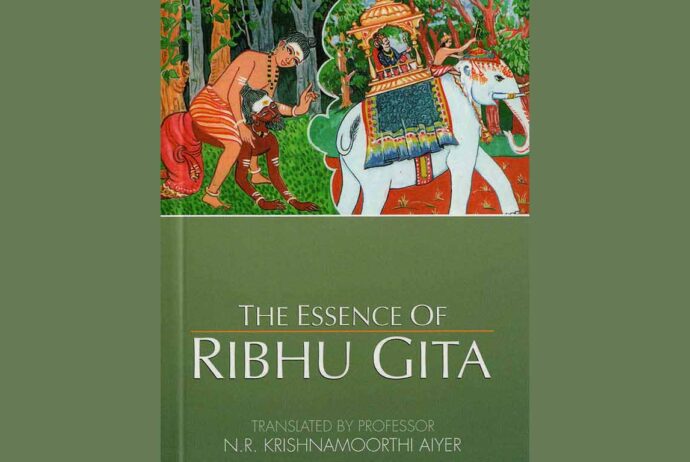
The Essence of Ribhu Gita

THE ESSENCE OF RIBHU GITA

Om Namo Bhagavate Sri Ramanaya

Benedictory verses

To Siva

1. Salutations to the Supreme Lord Siva, the pure Awareness in the sky of consciousness in the Heart, by meditation on whom, Ganesa, Guha, Mother-Sakti who is the embodiment of Siva’s Grace, and myriads of Devas, saints and devotees have attained their cherished goals. (Chapter 1, Verse 1).

To Nataraja

2. From the sky of consciousness of the Heart springs forth the dancer Nataraja with his blissful consort Freedom, to the delectation of his devotees who are thus liberated forever. Unto that Ananda Natesa do we render our devout salutations. (Ch.1, v.2)

To Ardhanareeswara

3. Unto that Form whose left half is the Mother of all manifestation and whose right half is the Father of the same, the jingle of the gems enclosed within the hollow golden anklet of whose foot is the source of all scriptures, and whose three eyes (Fire, Sun and Moon) are the illuminants of the universe, to that Form be our devout salutations. May that divine Form ever be our protection. (Ch.1, v.3)

To Siva, Sakti, Vinayaka and Shanmukha

4. Salutations to Siva, the Lord of the universe of infinite power, to Sat-Chit-Ananda-Sakti, the Mother of the universe, to Vinayaka the dispeller of all impediments to freedom, and to Shanmukha the Sat-Guru, who dispenses to his worthy devotees the divine wisdom of Siva-Self leading to salvation. (Ch.1, v.4)

THE ESSENCE OF RIBHU GITA

The following verses constitute the teachings of Siva to Ribhu, who in turn transmits those teachings to his disciple Nidhaga Rishi. The treatise goes by the name Ribhu Gita.

5. The universe was neither born, nor maintained, nor dissolved; this is the plain truth. The basic screen of pure Being-Awareness-Stillness devoid of all the moving shadow pictures of name and form of the universe is the sole, eternal Existence. (Ch.2, v.33)

6. Some may argue that this universe of duality (multiple existences) is a factual second reality, clearly seen by the senses operated by the mind. But then, are the senses anything apart from the mind? Can they function without the support of the mind in which they are imbedded? What is this mind except a bundle of thoughts? What are thoughts except evanescent ripples in the still, limitless ocean of pure Being-Awareness-Self, which is the sole Existence without a second? (Ch. 2, v.34)

7. The existence of the illusion of silver in mother of pearl is not a reality apart from the reality of mother of pearl, which is the basic reality. The illusion of the universe is based on the mind, which again is an illusion based on the still Awareness- Being-Self. (Ch.2, v.35)

8. In the unitary, undifferentiated still ocean of Existence- Awareness-Self, body, senses, mind, intellect and jivas (embodied souls) are nothing but evanescent ripples not apart from that sole Self. (Ch.4, v.6)

9. The universe of name and form, the embodied creatures and their creator, mind, desire, Karma (action), misery and everything other than the Self, are merely thought formations projected by the powers of the Self on its screen — Self. (Ch.5, v.25)

10. The state of firm abidance in that thought-free alert Awareness-Self, constitutes integral perfection, yoga, wisdom,Moksha, Sahaja Samadhi, the state of Siva and the state of Atman- Self, which scriptures proclaim by the title of Brahman. (Ch.5, v.26)

11. There never was a mind nor any of its countless forms like world, jivas, etc. There isn’t the least doubt that all these are the form of the eternally undifferentiable Supreme Brahman Self. This is the Truth. The one who hears this great secret diligently and understands completely, abides as Brahman-Self (Ch.5, v.28)

Greatness of Videha Mukta

12. With all objective knowledge banished, with no trace of thought or nescience, with all the three states of waking, dream and sleep wiped out, with all thought of death and birth abolished, and ever established in the spontaneous blissful state of Brahman-Self, the condition of the Videha Mukta cannot be conceived, and much less expressed in words. (Ch.5, v.39)

13. The continued repetition of ‘I am Self-Brahman’ constitutes the sole mantra-japa leading to Mukti (Liberation). All other mantra-japas connected with diverse gods should be firmly eschewed, as they aim at mundane objectives other than the Self. All other mantra-japas always entangle one inextricably in the bondage of worldly enjoyments. (Ch.6, v.37)

Sat-Chit-Ananda-Self Siva and His worship

14. On the eternal and infinite screen of Sat-Chit-Ananda- Self Siva, by His own power, Sakti is projected as the moving shadow picture of the universe in manifestation and into that again it is absorbed in dissolution.
All luminaries like the sun, moon, fire, stars and lightning derive their luminosity as a gracious gift from the Sakti inherent in that screen of Self-Siva only. Though bright in themselves, they can only obscure and cannot reveal the Siva-Screen which they cover up.
Out of fear of that Siva, their creator, Devas and Asuras (gods and demons) are ever alertly engaged in their ordained duties.
That Siva must be meditated upon and realised to be the Self, by making the restless mind stay still and alert after it has been adequately restrained, and completely prevented from the pursuit of sense objects, namely, the shadow pictures on the screen of the Self. All shadow pictures removed, what remains is pure Awareness, the spotlessly effulgent screen. Thus, Siva reveals Himself spontaneously as the sole eternal Sat-Chit-Ananda-Self, the very essence of the nature of the worshipper. (Ch.7, v.35)

The Jivan Mukta

15. The Jivan Mukta is a person liberated during his lifetime, who continues to have consciousness of the body and the world (as Brahman) along with his firm abidance in his Siva-Self. He ever abides in the blissful peace of Sat-Chit-Ananda. He is poised rock-firm in the conviction that he is not the body, and that his Being is the sole existence, the sole alert-awareness- bliss of Siva-Self Supreme. (Ch.8, v.1)

16. The Jivan Mukta has his consciousness completely dissolved beyond recognition in his Brahman-Self. Eternally alone in his Self, he is ever lost in the enjoyment of the bliss of his Brahman-Self. (Ch.8, v.25).

The Videha Mukta

17. The Videha Mukta* is free from the least trace of thought; he abides all alone in his effulgent pure-Awareness-Self in intense unbroken bliss, totally oblivious of limited forms, in a state of Maha-Mounam (stillness of body, speech and mind). (Ch.9, v.1)

* The term literally means the ‘disembodied-liberated person’. He is the matured adept, who at the moment of death, abides as the pure Sat- Chit-Ananda-Self.
Figuratively the term means mature liberated being who, while still alive, abides as the pure Sat-Chit-Ananda-Self without awareness of body and the world around him.

18. He is the pure embodiment of Sat-Chit-Ananda, all pervasive as ether, infinite as the sky, all alert with Awareness, spontaneously abiding as the perfect Brahman-Self in a state of still, unbroken, peaceful bliss. (Ch.9, v.15)

19. There is not an atom apart from the Self, which is the integral undifferentiated perfection of whole Being. Soul, world and Creator are inseparable from the Self. The reality of these is the reality of the Self only. (Ch.10, v.34)

20. All ignorance and illusion, all objects inert and living, all beings and non-beings, all the five elements, all the diverse worlds, all bodies and the lives that arise in them, not being apart from Brahman-Self, are Brahman-Self only. Existence alone is, for even non-existence acquires meaning only in Existence. Simply put, everything exists always as Brahman-Self only. (Ch.12, v.2)

21. All objective knowledge, all thought forms, all visible objects, all things heard, all questions and answers, all the food consumed and all other illusions, not being apart from the Self, should be regarded as Brahman-Self only. (Ch.13, v.2)

22. Therefore one should practise the habit of regarding everything as Brahman-Self only; until all thought of things other than the Self is lost. This condition once achieved, one should not give room for any thought and should ever abide inMaha-Mounam (peace of total stillness). (Ch.14, v.38)

23. Anything seen as other than Brahman-Self is bound to cause fear and trouble. Therefore, it behoves one to stick to the single attitude that everything sensed is Brahman-Self alone. In due course even this one thought must be given up, in order to abide firmly in the free undisturbed blissful state of the sole Brahman-Self. (Ch.15, v.5)

24. The total discarding of the mind is alone victory, achievement, bliss, yoga, wisdom and liberation. The sacrifice of the mind is, in fact, the totality of all sacred sacrifices. (Ch.15, v.7)

25. The firm denial of the existence of the mind and the firm belief in the existence of Brahman-Self, is the sure way to the conquest of mind, leading to the experience of the sole effulgent Self. (Ch.15, v.11)

26. If one gives the slightest room for the thought that the mind exists, pure Awareness itself will vibrate as the ruffled mind, which is the parent of all trouble and illusions. Therefore, one should ever abide in the conviction that there is no mind, and that the pure Awareness-Self is the sole Existence. This is the easy way to conquer the mind with all its vagaries. (Ch.15, v.12)

27. There is no such thing as the troublesome mind, no world of names and forms, not the least bit of ego. All these are nothing but the perfect Brahman-Self, which I am. In this conviction one should abide firmly, until one achieves the state of sleepless-sleep which is alert-peace-eternal. (Ch.16, v.7)

The True Samadhi

28. To hold on to the conviction born of Self-enquiry that “I am no doubt the Screen — Brahman-Self, and the world picture thereon, though evanescent, is no doubt ‘I am Self’ only”, and to abide still and blissful in that conviction is the acme of all sadhanas, like divine worship, charitable gifts, spiritual austerities, mantra-japa and samadhi as well. (Ch.16, v.41)

29. The Self alone is the spontaneous self effulgent Awareness; that alone is eternal bliss; that alone is Existence everlasting; that alone is all embracing perfection, the sole God- head without a rival and the sole primordial stuff of the Universe. In the conviction born of this experience, one should ever abide, as the sole I AM, the Supreme Self. (Ch.17, v.29)

Sahaja Samadhi

30. Remaining alertly aware and thought-free, with a still mind devoid of differentiation of Self and non-Self even while being engaged in the activities of worldly life, is called the state of Sahaja Nirvikalpa Samadhi (the natural state of abidance in the Self when all differentiation has ceased). This is called Akhandakara vritti, the ‘I’ of infinite perfection as contrasted with the ‘I am the body’ notion of those who have not realised the Self. (Ch.18, v.40)

Maturing of Sahaja Samadhi

31. Abidance in Sahaja Samadhi is the hallmark of a Jivan Mukta. With progressive development towards this state, an intensity of blissful peace is attained, leading on to the four successive stages of perfection in samadhi. Nothing short of this Sahaja Samadhi will be of any avail in destroying the fearsome cycle of births and deaths. (Ch.18, v.41)

32. That realised person who abides in the Brahman-Self, and has lost all feelings of differentiation of self and non-self, is the Jnani or Mukta Purusha. Such a Jnani is rare to find even by searching among millions of people. If one has the lucky opportunity of getting his darshan (personal view and contact) one attains purification from all his sins, and what is more, such a person’s ego gets liquidated at once. (Ch.19, v.10)

33. Darshan of the matured Jnani constitutes the acme of purification of baths taken in sacred waters, divine worship,mantra-japa, spiritual austerities, charitable acts and devotional worship of Lord Siva Himself. To find and to gain access to the sacred presence of such a Jnani is the luckiest of opportunities that one could ever obtain in this world. (Ch.19, v.11)

34. Worshipful service rendered unto such a Jnani-Sat- Guru quickens one’s spiritual wisdom to attain the bliss of jivan mukti. If continued further, it bestows on the disciple even the status of videha mukti. Therefore, if one is keen on being released

from bondage into the freedom of mukti, the one infallible means of achieving that aim is the loving and worshipful service of the Jnani-Sat-Guru. (Ch.19, v.13)

35. Firmly established in the Self, undisturbed by the least ripple of thought, as still as an idol of stone or wood, dissolved completely in Brahman-Self, even as water is in milk, with awareness devoid of all impurities of thought and drowsiness, standing clear as the pure sky, the grandeur of the Jnani’s nishta (firm stance in the Self ) defies thought and expression. (Ch.19, v.21)

The sine qua non of Mukti is Siva’s grace

36. That in which the whole universe is born and into which it is absorbed in dissolution, is the Siva-Self. Devoted worship of and meditation on that Siva-Self of pure Consciousness alone will attract Siva’s Grace, which is indispensable for liberation. (Ch.19, v.60)

37. Those engaged in the pursuit of knowledge of the Brahman-Self, happening to get involved in the mundane pleasures of sex, should regard such pleasures as merely faint shadows of the bliss of the Self. They should never even dream of worldly pleasures. (Ch.20, v.45)

38. As the Self is Sat, meditative contact with the Self is the true Sat Sanga (association with sadhus who abide in the Self ). As Brahman-Self is the highest, association with the Self is Mahat Sanga (highest association). (Ch.21, v.28)

39. The sadhaka practising meditation on the Self, should always think firmly that all diversities of soul, world and creator are the undifferentiated Brahman-Self only. By practice, his consciousness is freed from thoughts, after which he should give up the above thought also and abide always in the thought-free state of the Self (Ch.21, v.39)

40. Abidance in the state of thought-free alert Awareness, is the state of mukti beyond thought and expression. The emergence of thought is the bondage of untold suffering. Abidance in the Self is the true non-dual samadhi, and that alone leads one to the eternal bliss of mukti. (Ch.21, v.41)

41. The great illusions: maya (associated with God Iswara), avidya (associated with individual souls), mind and jivas (souls), world and its creator, all names and forms, and all mental conceptions are nothing but the Self. One should ever abide in this conviction. (Ch.22, v.23)

42. All worlds and creatures are only thought forms. They are nothing but the mind, which is a bundle of thoughts, which again are nothing more than ripples in the still ocean of Awareness-Self, and certainly nothing apart from that Self. Therefore, one should abide in the firm conviction that all objects are only I Am Self-Brahman. (Ch.22, v.24)

43. There are no such things as achieved objectives and the efforts leading to them, association with the wise or the ignorant, efforts of learning and knowledge acquired, acts of enquiry and practice, the learner or the learned, and any goals achieved. What exists is only Brahman, the effulgent Awareness- Self. (Ch.23, v.10)

44. One should be firm in the conviction that there are no charitable acts, sacred waters and kshetras (pilgrim centres), no loss or gain and no loser or gainer, no karma, bhakti and wisdom, and no knower or known. All these thought-forms are bound to be dissolved and lost in the Brahman-Self, which is the sole existence. (Ch.23, v.11)

45. The bhavana* ‘I-am-Brahman-Self’ swiftly takes one to mukti. As the continued reading of the texts generating thatbhavana, takes the aspirant unerringly to the goal, he should always dwell on the written words dealing with the Brahman- Self. (Ch.24, v.27)

* In verses 45 to 50 the word ‘bhavana’ means (lit. feeling) the faith based on the word of the teacher and the scriptures and in the unremitting abidance in the belief thereof.

46. The illusion that one is the body and that the world is the basic reality has remained soaked over a long, long time, and cannot be got rid of by the casual reading and mere understanding of the truth. The basic illusion can be effaced only by a long and unremitting practice of the bhavana that all this is ‘I-am-Brahman-Self’. (Ch.24, v.28)

47. Everything is only a concoction of time, space and energy. All else is the trite talk of people who dislike the effort of sadhana which takes them to the Self. This talk is based on their dense ignorance of the Self. Only by persistent practice and experience of sadhana, can one arrive at the truth that all concepts of souls, world, and the cause thereof are just evanescent shadows on the screen of Siva-Self-Brahman. (Ch.24, v.31)

48. There is never such a thing as conception of names and forms, no such thing as the conceiving mind, no such thing as a person lost in samsara, and no such things as the world and its creator. Everything that is seen to exist must be realised to be no other than the sole, pure Awareness-Being-Brahman-Self. (Ch.25, v.8)

Everything is Sat-Chit-Ananda-Self only

49. Whatever is found to exist is Sat (Existence) only. Whatever is pleasurable is Ananda (Bliss) only. One should ever abide in the bedrock bhavana of Sat-Chit-Ananda. Never for once should one slip, even inadvertently, into the disastrous bhavana that one is the body and that the world is real. (Ch.25, v.12)

50. One should abide in the rock-firm bhavana that ‘Everything is only Brahman-Self and I am that Brahman-Self ’. By this bhavana all thought movements and nescience will disappear, resulting in the eternal abidance in the sole Sat-Chit- Ananda-Self. (Ch.25, v.14)

51.* By abiding in the Self, the wandering mind is reduced to perfect stillness after being freed from all nescience and thought currents. It gets lost in the Sat-Chit-Ananda-Self in the same way that water is lost when mixed with milk. This unitary state of abidance in the Self is called Atma Nishta by the wise who have attained perfection. (Ch.26, v.2)

‘Sahaja Nishta’ or The Natural State

52. Having realised that the world picture on the screen- Self is evanescent and essentially non-existent, one should ever remain still and blissful in the firm conviction of ever being the sole Brahman-Self only. This conviction should be maintained even while functioning as an individual in the world of name and form. This matured state of abidance in the Self is called Sahaja Nishta (the Natural State). (Ch.26, v.3)

53. In that blissful Self wherein there is no action of body, speech and mind, no virtuous or sinful karma (action) and the fruits thereof, one should remain still, eschewing the least trace of thought. (Ch.26, v.7)

54. In that Self wherein there is neither conceiver nor conception of the world of names and forms, one should remain blissfully still, eschewing the least trace of thought. (Ch.26, v.8)

55. In that Self wherein desire, anger, covetousness, confusion, bigotry and envy are all absent; in that Self wherein there is no thought of bondage or release, one should abide blissfully still, eschewing the least ripple of thought. (Ch.26, v.13)

56. Firmly abiding in the Self one acquires the totality of all knowledge and achieves the successful completion of all endeavours and duties. In that state one should abide blissful and still, eschewing the least ripple of thought. (Ch.26, v.25)

* Verses 51 to 60 herein deal with practice of‘AbedhaNishtaorAtmaNishta’— non-dual state or abidance in the Self.

57. Mind merged completely in the Self, one becomes a lord without rival-steeped in bliss beyond compare. In that state one should abide still, free from the least trace of thought. (Ch.26, v.28)

58. I am that Self which is integral existence awareness- bliss, the sole impartite Brahman-Self. Firm in the conviction born of this experience, one should abide still, free from the least trace of thought. (Ch.26, v.29)

59. In the conviction that ‘I am the Self’ in which no thought, ego, desire, mind or confusion can exist one should abide still, free from trace of thought. (Ch.26, v.31)

60. The firm faith of being the Self is sufficient to dispel all thought and establish one in Brahman-Self. In due course of this practice, even the thought involved in that faith fades away leading to the spontaneous effulgence of the Self. If a person hearkens to this teaching and practises the faith, even if he is a great sinner, he is washed clean of all his sins and is established in Brahman-Self. (Ch.26, v.42)

61. There is certainly no such thing as mind with its constituents of thought and thought forms of objects. In this conviction one should ever abide still and at peace, in the state of thought-free alert Awareness-Self which endures after all sadhanas and its rigours have exhausted themselves in Brahman- Self. (Ch.27, v.29)

62. Having gained the experience that there is no creator, no maya, no duality, and no objects at all, and that pure Awareness-Self alone exists, one should ever remain still and peaceful in that state of Selfhood. (Ch.27, v.34)

63. If a person gives heed to these teachings he would certainly gain the grace of Lord Siva and attain the state of Selfhood even though he is immersed in the dense darkness of nescience which could not be banished by the glare of a million suns. (Ch.27, v.43)

64. Why waste words? This is the truth in a nutshell. Only those who have earned the Grace of our Lord Siva by long devotional worship will get the rare opportunity of reading this scriptural text which leads to the bliss of peace everlasting in Brahman-Self. (Ch.27, v.44)

65. Only that Jnani who teaches ‘Thou art the thought- free, alertly aware, absolutely still, ever blissful, intensely peaceful, unqualified Brahman-Self’, is the true Sat Guru, and others are not. (Ch.28, v.28)

66. Unbroken abidance in the state of alert awareness, unruffled by thoughts, is Self-realization. That is at once the spotless jivan mukti and the magnificent videha mukti. This state is easily attainable only for those who have earned the divine Grace of Siva by deep devotion to Him, and not for others. What is stated here is the import in a nutshell of the message of that charming crest jewel of the Vedas known as the Upanishads. (Ch.29, v.37)

67. Thos who give heed to this message and abide in accordance with it will forthwith attain mukti (liberation). They will not suffer from the least particle of affliction; they will enjoy a bliss far greater than the bliss attained from this and all other worlds; they and their environments will be filled with the plenitude of auspicious events. Totally free from all trace of fear, they will never again enter the cycle of births and deaths. They will become the immutable Brahman- Self. All this we swear is the truth beyond doubt. By our Lord Siva, again and again we swear that this is the fundamental truth. (Ch.29, v.40)

68. That state of still, pure, effulgent awareness is moksha, the state beyond compare. Those who maintain an unbroken abidance in that supreme state will never more be touched by suffering or confusion, and will be absolved from all duties. Such duties if any will somehow be completed without any volition on their part. They will eternally abide as the sole supreme Self. (Ch.30, v.31)

69. By the persistent and continued bhavana * of ‘I am the Brahman-Self’ all thoughts and feelings of differentiation of Self and non-Self will drop off and permanent abidance in Brahman-Self will be achieved. This bhavana is possible only for those with a keen inquiring mind intent on knowing the Self and not for those who are indifferent about Self-knowledge. (Ch.32, v.18)

70. Ignorance and indifference in regard to the enquiry of the truth about one-self is the store house of nescience and trouble, blocking the view of the Self, and creating in a split second all sorts of illusions and harassment of mental worry. Non-enquiry renders bhavana impossible. (Ch.32, v.19)

71. In short, non-enquiry will steep one for ever in the ocean of samsara (earthly suffering). There is no greater enemy for one than non-enquiry. Therefore, this habit must be overcome in order to fix the mind in the bhavana which leads to abidance in the Self. (Ch.32, v.20)

72. Enquiry should be made this wise: With the kind help of the Sat Guru one should enquire ‘Who am I? what is this world? what is the reality behind all these?’ (Ch.32, v.21)

73. Staying in the company of sadhus (those engaged in the pursuit and enjoyment of the bliss of the Sat-Self ) and respectfully questioning the Sat-Guru-Jnani, one should first make oneself clear about the objective to be obtained. This is an important aspect of the enquiry. After thus making sure of the objective, one must firmly abide in that objective of sole Brahman-Self until the Self is unmistakably experienced. (Ch.32, v.22)

74. The conscious introspective concentration of Self- enquiry (‘Who am I’?) kills all thoughts and destroys the dense darkness of nescience; it effaces all worry; it illuminates the intellect with the radiance of pure awareness; it wipes out all conceptual confusions; it fixes one in Siva-Self; it transforms a host of impending disasters into auspicious events; and lastly, it destroys the ego-mind utterly with all its afflictions. (Ch.32, v.24)

* In all the 13 verses of Chapter 32, the term bhavana is to be understood as faith or firm belief in ‘Aham Brahmam’ (I am the Self ).

75. Only by those strong willed persons who make earnest and persistent Self-enquiry will the turbulent mind be controlled and fixed still in the practice of firm bhavana. In due course all thoughts and nescience will disappear, yielding place to the effulgent Awareness-Self of mukti. (Ch.32, v.26)

76. One should relentlessly pursue Self-enquiry until all conceptual forms of creature, world and creator merge and disappear in the pure thought-free, alert Awareness-Self, enabling one to abide in that bhavana of the experience, ‘I am the Brahman-Self’. (Ch.32, v.27)

77. It is only the mind which appear as the world and bondage; there is no world other than the mind. On enquiry this mind turns out to be nothing more than a group of ripples (thoughts) in the still ocean of pure Awareness-Siva-Self. I am that Siva-Self only and there is nothing apart from me, one should ever abide in the conviction born of this experience. (Ch.32, v.33)

78. There is no world apart from the mind. What appears as the world is only the mind. If this mind is investigated, it turns out to be nothing more than a bundle of thoughts based on the primary thought of ‘I am the body’ called the ego. If this ego — I is enquired into and its identity searched, it gets swallowed up without a trace in the pure Awareness-Being-Siva- Self. One should maintain this firm bhavana ‘I am Self-Siva’ until that state of being the Siva-Self — becomes the spontaneous experience free from the effort of bhavana. (Ch.32, v.34)

79. In me, the pure Awareness-Self, the universe is born, maintained and dissolved as the mind. Therefore, there are no mind and thought forms of objects apart from me the Self. In this firm experience one should ever abide. (Ch.32, v.35)

80. One should ever abide as pure Siva-Self by the firm experience that there are no thought forms of creature, world and creator apart from the mind which is just an array of ripples in me the still ocean of pure Awareness-Self and therefore I am the sole Being Siva-Self only. (Ch.32, v.36)

81. Even as the world, seen in my dream, is not apart from me but only my creation, even so, the world of the waking state is only a creation made by me and seen by me in the medium of my pure Awareness-Self. In this experience one should firmly abide. (Ch.32, v.37)

82. The rock-firm conviction of ‘I am the Self ‘ is the sure mark of firm abidance in the Self. Abidance in that conviction under all conditions is, true divine worship, meditation on God, incantation of mantras, practice of right conduct in life, contemplation, integral yoga, wisdom of the Self and moksha as well. (Ch.33, v.16)

83. Whatever appears as maya, creator, creature, mind, world, names and forms are the pure Brahman-Self only and not apart from that Self. (Ch.34, v.15)

84. Steady abidance in the rock-firm conviction born of the experience of ‘I am the Self’, is the greatest yoga, total dissolution of the mind, true renunciation, true wisdom, and jivan mukti as well. (Ch.34, v.46)

85. Whatever names and forms are seen by me in my dream are not anything apart from me. Even so, this world seen by me in my waking state is not anything apart from me, the Awareness- Self that I am. The wise one should give up all differentiation of Self and non-Self, and abide as pure Self only. (Ch.35, v.23)

86. If this world of the waking state is not evanescent in its nature, whatever is seen in the waking state must be seen during sleep also. Since I as pure Self exist alone and always, there is no room for thought of non-Self-world. I-Self-Brahman is the sole Existence. (Ch.35, v.24)

87. No world exists during the absence of the mind, and there is no mind apart from my awareness. So, mind and world are nothing apart from the Self, and I am ever that sole Existence-Awareness-Brahman-Self. The wise one should abolish all thought of differentiation of self and non-Self. (Ch.35, v.25)

88. I see neither mind nor world during my sleep. In my dream there is mind with its creation, the dream world. The dream world is falsified in my waking state. But I-Self exist always. Arguing thus, one must give up all differentiation of self and non-Self, and ever abide firmly as the thought-free alert Awareness-Self-Brahman. (Ch.35, v.26)

89. All diversities of world, mind, maya (confusing power of Brahman), wakefulness, dream, sleep, talk of you and me are evanescent, and yet, not apart from the Self. Thus wise one should give up all thought of Self and non-Self and abide as Self only. (Ch.35, v.27)

90. In dim light the illusion of a serpent is seen in a rope, and this serpent is nothing but the rope. Even so all illusion of non-Self exists in the Self only. Thus wise one should give up all thought of Self and non-Self and ever abide firmly in the peace of the Self. (Ch.35, v.28)

91. In the wisdom of integral experience, I am the non- dual, transcendental, motionless, peaceful, bondage- freedom-notion-free, sky of pure consciousness only. With this experience one should reject all differentiation of Self and non-Self and ever abide firmly in the peace of Brahman- Self. (Ch.35, v.33)

92. One should give up all hatha yogic practices like breath control, all religious dogmas and their diverse sadhanas and be ever satisfied in simple abidance as the Self only. (Ch.35, v.38)

93. Only those who contemplate on Lord Siva-Self, the pure supporting screen of all manifestation, gain the pure experience of sahaja nirvikalpa samadhi. Apart from this devotion to Lord Siva (the Pure-Alert-Awareness- Self) there are no other means leading to liberation. (Ch.35, v.44)

94. The non-dual sole being existing in deep sleep conjures up a world in the dream state. Even so, the shadow world conjured up in the waking state is the work of the power, inherent in one’s own Brahman-Self. Abiding firmly in the experience of pure Brahman-Self, one finds that the mind and all its confabulations are lost for ever. (Ch.36, v.25)

95. One should remain firm in the conviction ‘I am the Self’ and reject all thoughts like ‘I am this body’ and ‘This world is real’. If one maintains this habit unremittingly, this false belief will drop away even as a flower held in the hand slips away when one falls into deep slumber. (Ch.37, v.33)

96. One is solely responsible for one’s own liberation or bondage, since the choice of destroying the restless mind or allowing it to roam at large rests with that one only. Therefore, one should conquer the restless mind by steady abidance in the pure thought-free Alert-Awareness-Self only. This steady abidance is moksha. (Ch.38, v.7)

97. You are the sole supreme Godhead, the Self. There is nothing apart from you. This, we declare to be the ultimate truth after a complete analysis of all the scriptures. By the holy feet of Siva, we swear this to be the truth beyond all doubt. By the feet of the Sat Guru, we swear again that this is the truth declared by the Upanishads. (Ch.38, v.9)

98. All charitable gifts, all pilgrimages to sacred places, all sorts of mantra-japa and worship of diverse gods must be firmly given up in favour of steady practice of the teachings of this book only. (Ch.38, v.24)

99. All yogic practices, all philosophic pursuits, all devotional exercises, and all faiths and beliefs should be abandoned. One should confine oneself to practice of the teachings of this book only. (Ch.38, v.25)

100. By the sole practice of the teachings of this book, all confusion and ignorance will be destroyed. Firm abidance in the Self will be the positive result. With the fusion of the wisdom and peaceful bliss in the Self, mukti will be attained. (Ch.38, v.29)

101. Only when all sins are washed off by the practice of virtues running through many lives, one gets the rare opportunity of securing this treatise and practising its tenets. By the feet of Lord Siva we declare that only those whose cycle of births and deaths has come to an end with this life will ever get this treatise in their hands and practise its teachings. (Ch.38, v.40)

Verses 102 to 121. these 20 contain the declarations of the disciple Nidaga before his teacher Ribhu, expressing the spiritual achievements secured by him by the grace of his teacher, and expressions of his gratitude to his teacher, Ribhu.

102. O My Lord Sat Guru! By thy grace I have, in a split second, shed all sense of differentiation of Self and non-Self; I have attained the certainty that all is Brahman and I am that Brahman-Self; I have become settled in the eternal bliss ofBrahman-Self. (Ch.39, v.7)

103. I am verily the Sat-Chit-Ananda-Brahman-Self. I am the eternal undisturbed peace devoid of name and form. I am the flawless integral whole of all existence. Firmly I am settled in my sole Brahman-Self. (Ch.40, v.10)

104. Oh! I have become Brahma, Vishnu, Rudra, Mahesa, Sadasiva, Parameswara and his spouse Parvati, Vinayaka, Subrahmanya, cohorts of sides hosts (Siva ganas) and devotees of Lord Siva, all rolled into one! (Ch.41, v.-15)

105. I am myself all the devas (celestials beings) and asuras (denizens of the nether world), Indra the Chief of the devas, the Lord of the eight cardinal directions, the community of sages, the swarm of rakshasas (demons), and in fact, the denizens of this and all other worlds. (Ch.41, v.16)

106. I have become the five elements, multitudinous worlds scattered in the skies, all existing things and their histories, all the Vedas, and all the diversities of name and form. (Ch.41, v.17)

107. At one stroke I have become the bodies, senses, and souls owning them, the mind, intellect, intuition, ego, the primal nescience and the restless commotion of spirit, and in short all that is seen and known. (Ch.41, v.19)

108. That gracious person who gives these teachings is no doubt the embodiment of Lord Parameswara, His Devi Parvati,Vinayaka and God Shanmukha all rolled into one. (Ch.4, v.5)

109. He is again, Nandikeswara, Dattatreya, Dakshinamurti, and in short, the Supreme Lord Siva Himself (Ch.42, v.6)

110. After being duly initiated into these teachings by the Sat Guru, the disciple must, as long as life lasts in him, provide his teacher liberally with money, food, clothing and shelter and loving devotion. This is the sine qua non for the disciple’s mukti. (Ch.43, v.11)

111. Further, he should adorn his forehead and body with vibhuti (sacred ash) in the prescribed manner, as this use ofvibhuti alone will entitle him to Lord Siva’s grace which removes all impediments to salvation. (Ch.43 v.12)

112. The habitual smearing of the body with vibhuti is called pasupatha vratham (austerity in devotion to Siva). This practice quickens the attainment of Self-knowledge. O Lord Sat Guru! By this practice I earned the merit for arriving at thy holy feet which have led me to salvation. (Ch.43, v.13)

113. I am ever the eternal, pure, all knowing, free, unshakeable, non-dual, integral Self. This is the firm conviction of the experience of the jivan mukta in the Self. (Ch.43, v.28)

114. That mature Jnani who is lost in the maha mounam (total stillness) of the pure effulgent Awareness-Brahman-Self, devoid of the least trace of nescience, totally devoid of all consciousness of the body and its three states of waking, dream and sleep, devoid of all distinctions of name and form and devoid of any thought of bondage or freedom is a videha mukta. (Ch.43, v.29)

115. Thou hast, O Lord Sat Guru, taken me across the boundless ocean of samsara in the boat of Self-knowledge. To me, floundering in the misery of the belief that ‘I am the body’ thou hast taught that ‘I am the Brahman-Self’ and vouchsafed to me the bliss of all embracing Awareness-Being. To thee, I render these devout salutations. (Ch.44, v.16)

116. Salutations to thee, my Lord Sat Guru! Thou hast destroyed my illusion that I am the body and that the world is apart from me and is real. Thou hast given me the experience of my own Brahman-Self. Thou hast destroyed my wrong belief that karma (action) is the road to salvation, and showing that knowledge alone could make one free. Thou hast given me my salvation in the Self (Ch.44, v.17)

117. To that divine Grace-embodied, to that Omnipresence beyond compare, to that Siva-Self Sat Guru, I render devout salutation. (Ch.44, v.18)

118. To that Sat Guru who is the core of my Self, who destroyed my nescience by the gift of Awareness-Self, to that embodiment of Self-knowledge, do I offer these salutations. (Ch.44, v.19)

119. Salutations to the Sat Guru who is the embodiment of undisturbed peace, without attributes, eternal purity, all pervasive infinite sky of consciousness and integral perfection (Ch.44, v.20)

Note:- The following verses 120 and 121 contain Ribhu’s exhortation to Nidaga.

120. In reply to the words of Nidaga, Ribhu replies thus: O my son! You are now no doubt firmly settled in the bliss ofBrahman-Self, having been freed from all illusion and nescience. All the same, as abundant precaution, until you attain videha mukti you must assiduously practise continued abidance in the Self. (Ch.44, v.22)

121. Aspirants of Self-knowledge will find their success accelerated by practical bodily worship of Siva. Living in a Sivakshetra (neighbourhood of Siva Temple) they should offer worship to Siva Maha Lingam, wearing the sacred vibhuthi andrudraksha (garland of a specified sort of beads), and repeating the name of Siva with loving devotion. (Ch.44, v.39)

122. BenedictoryVerseofferingsalutations to Siva-Self.

Salutations to Sat-Chit-Ananda-Siva-Self!
Salutations to that Peace undisturbed, the Self! Salutations to that integral Perfection, the Self! Salutations to that Effulgent-Awareness, the Self! Salutations to that blemish-free Self without attributes! Salutations to that indivisible Unity, the Self! Salutations to that pure sky of consciousness, the Self! Salutations to that supreme integral Existence, the Self!

(Ch.44, v.51)
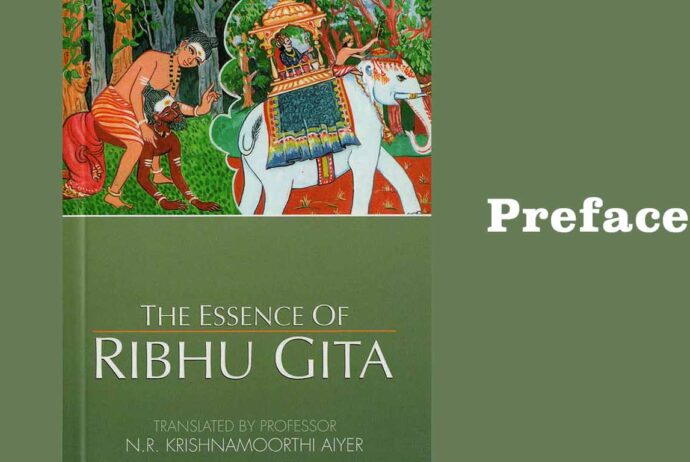
 

The Essence of Ribhu Gita – Preface

Essence of Ribhu Gita – Preface


PREFACE

The Ribhu Gita forms the sixth section of the Sanskrit work known as Siva Rahasya. It is the teachings of Lord Siva in Mount Kailas to His devotee Ribhu, from whom the Gita derives its name.

The Ribhu Gita was translated into Tamil verse by a Brahmin Vedic scholar of high repute, by name Bikshu Sastrigal who was also an accomplished scholar in Tamil. He translated the work under the name of Ulaganatha Swamigal, and because of his efforts attained renowned fame among the Tamil devotees of Siva.

The Tamil version is a free translation of the original Sanskrit text, consisting of 1,924 verses of such scintillating brilliance that Bhagavan Sri Ramana Maharshi recommended its recital as a strong support for spiritual sadhana. He used to say that the recital itself leads to spontaneous abidance in the Self.

The book presented herewith consists of 122 verses from the original Tamil work, being a free translation into English prose, conveying the essence of the original, rather than a mere mechanical word for word translation.

Reading of this English text alone will not be complete unless it is supported by vigorous sadhana with the help of a realised teacher, who has obtained firm abidance in Siva-Self by a life of devotion to Lord Siva. This aspect is stressed in some of the verses selected.

It is the earnest hope and prayer of the translator that after reading this English text, devotees all over the world would make the pilgrimage to Tiruvannamalai, and complete their sadhana in the immediate presence of Lord Arunachala Siva and Sat Guru Ramana enshrined in His samadhi in Sri Ramanasramam.

Prof. N. R. KRISHNAMOORTHI AIYER. (Translator)
Sri Ramanasramam, Tiruvannamalai 
15th August, 1984.

Click here for other Scriptures

Kaivalya Upanishad – Sanskrit Verses & English Meaning

Kaivalya Upanishad – Sanskrit Verses & English Meaning

Kaivalya (Liberation, Salvation) Upanishad (Upa-ni-shad). These Verses were often quoted by Bhagavan Sri Ramana Maharshi. They were also chanted daily in His presence. The meaning of these Verses are profound and very helpful for someone who is seeking peace of mind and self-realization.

Kaivalya Upanishad Meaning in English (by Swami Chinmayananda)

Peace Invocation

Om bhadram karNebhihi shruNuyaama devaahaa
bhadram pashyemaakshabhir yajatraahaa
sthirairarangaistushtuvaamsastanuubhihi vyashema devahaitam yadaayuhu
svasti na indro vruddhashravaahaa svasti naha pooshaa vishvavedaahaa
svasti nastaarkshyo arishtanemihi svasti no brihaspatirdadhaatu
Om shaantihi shaantihi shaantihi

Om.  (OM indicates the Real Self, Brahman.)
Oh Gods! May we hear with our ears always what is auspicious.
Oh! Worshipful ones! May we see with our eyes always what is auspicious.
May we live our entire length of our allotted life hale and hearty offering our praises unto you.
May Indra (Lord of Actions) the ancient and renowned, bless us.
May Poosha (Lord Sun) the all-knowing, bless us.
May Vayu (Lord Wind) the Lord of Swift-motion who saves us from all harm, bless us.
May Brihaspati (Guru of Gods) who protects the spiritual wealth in us, bless us.
Om Shantihi, Shantihi, Shantihi. (Om, Peace only, Peace only, Peace only.)

(Om Shanti is chanted three times above in order to ward off obstacles to our learning, arising from three areas.
They are as follows:
Adhi-Daivika (Divine forces such as lightning and thunder);
Adhi-Bhautika (Forces such as fire, floods, and landslides);
Adhyatmika (purely subjective ones such as inertia, lack of faith, insincerity and so that arise from our own negativities.)

athaashvalaayano bhagavantam parameshtinamupasametyovaacha

adhiihi bhagavan brahamavidyaam varishthaam sadaa sadbhihi sevyamaanaam nigoodhaam
yayaachiraat sarvapaapam vyapohya paraatparam purusham yaati vidvaan – 1

1. Then Asvalayana approached the highest Lord (the Creator Brahmaa) and said: Oh Bhagavan, teach me the highest Science of Reality, cultivated always by good people, which is ever a hidden secret for man, a knowledge by which a wise man, discarding all sins, can reach the Highest. 

tasmai sa hovaacha pitaamahaascha shraddhaa bhakti dhyaana yogaadavaihi – 2

2. To him (Asvalayana), the Grandsire Brahmaa said: Know this supreme knowledge by Faith, Devotion and Meditation (Yoga). Brahmaa is one of the gods of Trinity created by the Supreme Power to carry out the task of creation. He should not be mistaken with the Brahman of the Upanishads, the Self of the nature of Existence-Consciousness-Bliss.

na karmaNaa na prajayaa dhanena tyaagenaike amritatvamaanasuhu
pareNa naakam nihitam guhaayaam vibhraajate yadyatayo vishanti – 3

3.  Neither by work (actions), nor by offspring (progeny), nor by wealth, but by renunciation alone, Immortality (eternal life) is attained. Higher than the heaven, seated hidden in the cave of the intellect,  it shines. Self-controlled seekers enter into it.

vedaantavignyaana sunischitaarthaahaa sanyaasayogaad yatayahaas shuddha sattvaahaa
te brahamalokeshu paraantakaale paraamritaat parimuchyanti sarve – 4

4.  Those who are pure in mind, striving through the path of renunciation, come to ascertain clearly the deeper imports of the Knowledge, which is the theme of the Upanishad (Vedanta). In the end, they gain the world of Brahma, and liberating themselves from everything, gain the Highest Immortality.

viviktadeshe cha sukhaasanasthahaa suchis samagreeva shirass shareerahaa
atyaasramasthaha sakalenDriyaaNi nirudhya bhaktyaa svagurum praNamya
hritpunDareekam virajam vishuddham vichintya madhye vishadam vishokam – 5

5. In an undisturbed place, resting in a comfortable posture, clean and pure, with neck, head and body held erect in one line, in a mental attitude of Sanyasa (renunciation), having controlled all the senses, saluting one’s own Teacher mentally with reverence, meditate within the lotus of the Heart, the Untainted, the Pure, the Clear and the Griefless.

achintyam avyaktam anantaroopam shivam prashaantamam amritam brahamayonim
tathaa aadimadhyaanta viheenam ekam vibhum chidaananDamaroopam adbhutam – 6

6. The Unthinkable, the Unmanifest, the One of endless forms, the Ever-auspicious, the Peaceful, the Immortal, the Origin of the very Creator, the One without a beginning, a middle or an end, the Only One, the All-pervading, the Knowledge-Bliss, the Formless, and the Wonderful.
Note: Here in these terms the Eternal Truth, the Self, is indicated. These terms are given for the purpose of contemplation in the ‘cave-of-the-Heart’.

umaasahaaayam parameshvaram prabhum trilochanam neelakanttam prashaantam
dhyaatvaa munirgachchhati bhootayonim samastasaakshim tamasaha parastaat – 7

7. By meditating upon Lord Parameswara (Siva) with Goddess Uma as his consort –  the Highest Lord, the All-powerful, the Three-eyed, the Blue-necked and the Ever-tranquil – a true man of reflection reaches Him who is the Source of all the manifested world, the Witness of all, and who is Beyond all darkness. 
Note: The third eye mentioned above is the Eye of Intuition, the Vision of Pure Knowledge.  The blue-necked is in the glorious story of Lord Siva, where in order to stop poison from harming all people, He drank it and held it in this throat. It is symbolic of a higher spiritual meaning.

sa brahamaa sa shivahaa senDrahaa soksharahaa paramas svaraat
sa eva vishNuhs sa praaNahaa sa kaalogni sa chanDramaahaaa – 8

8. He is Brahmaa, He is Siva, He is Indra. He is the Immutable, Imperishable, the Supreme, the Self-luminous. He alone is Vishnu, He is Prana, He is Time and Fire. He is the Moon. 
Note: Siva in the form of Iswara is one of the Trinity. (Brahmaa (Creator), Vishnu (Sustainer), Siva (Cosmic Balancer). However, here Siva is depicted as the God of all Gods, the Supreme Brahman.

a eva sarvam yadbhootam yachcha bhavyam sanaatanam
gnyaatvaa tam mrityumatyeti naanyahaa panthaa vimuktaye – 9

9. He alone is all that was, and all that will be, the Eternal.  Knowing Him one goes behind the sting of death. There is no other way to attain complete Freedom.

sarvabhuutasthamaatmaanam sarvabhuutaani chaatmani
sampashyan brahama paramam yaati naanyena hetunaa – 10

10. Experiencing one’s own Self in all beings and all beings in the Self, one attains the Highest Brahman, and not by any other means.

aatmaanamaraNim kritvaa praNavam chottaraaraNim
gnyaananirmathanaabhyaasaat paasham dahaati panDitaha – 11

11. Making the ego the ‘lower arani’ and OM the ‘upper arani’, by repeated churning through the practice of the Path of Churning of Knowledge, a wise man burns up all the cords of his bondage.
Note :
Arani:
Between two cups scooped in wooden blocks, a cylindrical rod of wood is fixed perpendicular, and the rod is rotated by a piece of rope. When the perpendicular wooden rod is churned between the pressed upper and lower blocks (arani’s), due to the friction, first a piece of cotton catches fire, and from it fire can be obtained as necessary.
OM: OM, actually AUM, represents the Highest Being. ‘A’ denotes the beginning, ‘U’ the middle and ‘M’ the end. A is the innermost sound produced from deep inside, ‘U’ the middle sound is produced from the throat, and ‘M’ is the outermost sound produced from the lips. Therefore, AUM defines the Self as the Beginning, Middle and End of all Beings. AUM also stands for the Waking state (A), the Dream state (U) and the Deep sleep state (M). The Silence after chanting OM indicates the state of Blissful Being.

sa eva maayaaparimohitaatmaa shareeramaasthaaya karoti sarvam
striyannapaanaadivichitrabhogaihi sa eva jaagratparitriptimeti – 12

12. The Self deluded by Maya (Illusion) is he, who identifying with the body, does all actions (all perceptions, feelings and thoughts). In the waking state it is he (this Jiva) who engages in gratification through the varied objects of enjoyment, such as woman, food, wine, etc.
Note : Here the word “woman” should be taken be carnal pleasures and sensuous objects.

svapne sa jiivahaa sukhaduhkhabhoktaa svamaayayaa kalpitajevaloke
sushhuptikaale sakale vileene tamobhibhuutahaa sukharuupameti – 13

13. That very same individualized ego, in the dream state, experiences its pleasure and pain, in a field of existence created by its own Maya (misapprehension of Reality). During the state of profound sleep when everything is merged, it is overpowered by Tamas (ignorance or non-apprehension) and comes to exist as deep happiness or Bliss.  
Note : The happiness that is referred in this verse is not a positive state of mental happiness, but a negative state of temporary escape from the vagaries of the mind.

punashcha janmaantarakarmayogaat sa eva jiivahaa svapiti prabuddhahaa
puratraye kreeDati yashcha jeevastatastu jaatam sakalam vichitram
dhaaramaananDamakhanDabodham yasmimallayam yaati puratrayam cha – 14

14. Again, due to its connection with the deeds done in its previous births, that very same individuality (Jeeva) comes back to the dream or the waking-state. The being who sports thus in the ‘three cities’ (waking, dream and deep sleep), from Whom has sprung up all diversities, He is the substratrum, the Indivisible Bliss-Consciousness, and in Him alone the ‘three cities’ go into dissolution. 

etasmaajjaayate praaNo manahaa sarvenDriyaaNi cha
kham vaayurjyotiraapahaa prithivii vishvasya dhaariNee – 15

15. From ‘This’ is born Prana (Vital Force), mind, all organs, Space, Air, Fir, Water and Earth that supports all.

yatparam brahama sarvaatmaa vishvasyaayatanam mahaat
sookshmaatsuukshmataram nityam tattvameva tvameva tat – 16

16. That which is the Supreme Brahman, the Self in all, the Support of the Universe, Subtler than the subtle and Eternal, That alone You are. You alone are That.

jaagnat svapna sushhuptyaadi prapancham yatprakaashate
tadbrahamaahaamiti gnyaatvaa sarvabanDhaat pramuchyate – 17

17. “That which illumines the worlds of relative experiences lived in the waking, dream and deep sleep conditions, that Brahman am I” – realizing thus (by experience), one is liberated from all shackles.

trishhu dhaamasu yadbhognyam bhoktaa bhogashcha yadbhavet
tebhyo vilakshaNas saakshii chinmaatroham sadaashivahaa – 18

18. All that constitutes the enjoyable, the enjoyer and the enjoyment in the three realms, different from them all am I, the Witness, the Ever-Auspicious Pure Consciousness.

mayyeva sakalam jaatam mayi sarvam pratishhThitam
mayi sarvam layam yaati tadbrahamaadvayamasmyahaam – 19

19. In me alone everything is born, in me alone does everything exist, and in me is everything dissolved. I am that non-dual Brahman.

aNoraNiyaanahaameva tadvanmahaaanahaam vishvamahaam vichitram
puraatanoahaam purushhoahaamiisho hiraNmayoahaam shivaruupamasmi – 20

20. I am smaller than the atom (the smallest) and I am also vast, greater than the greatest. I am the manifold Universe and Amazing. I am the Ancient One, the Self, the Supreme Ruler am I, the Effulgent One, by nature Ever-Auspicious, the Siva of golden hue in manifestation. 

apaaNipaadoahaamachintyashaktiH pashyaamyachakshuH sa shriNomyakarNaha
ahaam vijaanaami viviktaruupo na chaasti vettaa mama chitsadaaahaam
vedairanekairahaameva vedyo vedaantakridvedavideva chaahaam – 21

21. I am without hands and legs, of incomprehensible Power. I see without eyes and hear without ears. Devoid of forms, I am ‘Knowing’ of everything, and there is none who knows me. I am ever Pure-Knowledge. 

na puNyapaape mama naasti naasho na janma dehenDriyabuddhirasti
na bhuumiraapo na cha vahanirasti na chaanilo measti na chaambaram cha – 22

22. I alone am, the theme taught in the different Vedas. I am the Revealer of the Upanishads, the Vedanta, and I alone am the real knower of the Vedas. For me there is neither merit nor demerit. I do not suffer any destruction. I have neither birth nor body, sense organs nor the mind-intellect equipment.

evam viditvaa paramaatmaruupam guhaashayam nishhkalamadvitiiyam
samastasaakshim sadasadvihiinam prayaati shuddham paramaatmaruupam – 23

23. For me there is neither Earth nor Water nor Fire, nor Air, nor Space. Thus realizing the nature of the Paramatman – the Higher Self – the one who abides in the cavity of the Heart – who is without parts, without a second (non-dual), the witness of all, beyond both existence and non-existence – then one attains the very nature of the Paramatman, the Higher Self. 

iti prathamaha khanDaha

End of Part I.
Note : It is specified that here ends the first part of this Upanishad. But actually there is no second part. But at the close of this Upanishad we find two more Mantras which are provided for the seekers as encouragements to practice the teachings of this Upanishad.

yaha shataruudriiyamadhiite soagnipuuto bhavati suraapaanaatpuuto bhavati
brahamahaatyaatpuuto bhavati krityaakrityaatpuuto bhavati tasmaadavimuktamaashrito
bhavati atyaashramii sarvadaa sakridvaa japet

24. He who studies Satarudreeya (a prayer of hundred verses invoking Rudra, Lord Siva) becomes purified as fire, becomes as pure as air. He becomes purified from (the sin of) drinking, from killing a Brahmana (knower of the Brahman, the Higher Self), from stealing gold, from sins arising out of all commissions and omissions. Therefore he obtains refuge in the One who never leaves the Existence-Consciousness, who is free from the need for freedom, the Siva, the Supreme Self. One who belongs to the highest order of life should repeat this prayer always, or at least once. 

anena gnyaanamaapnoti sansaaraarNavanaashanam tasmaadevam viditvainam kaivalyam
phalamashnute kaivalyam phalamashnuta iti

25. By this one attains the knowledge that destroys the endless experience of change (the cycle of births and deaths). Therefore, having experienced this, one attains the fruit of Liberation (Kaivalya). Indeed one attains Liberation (Salvation).

iti dvitiiyaha khanDaha

End of Part 2.

ityatharvavede kaivalyopanishhatsamaaptaa

Here ends the Kaivalya Upanishad belonging to the Atharva Veda.

The End

Siva Aparadha Kshamapana Stotram

Siva Aparadha Kshamapana Stotram

Hymn By Sri Adi Sankaracharya

॥ श्रीशिवापराध क्षमापणस्तोत्र ॥

Siva Aparadha Kshamapana Stotram – Audio Musical Chanting by Pandits


VERSE 1:

Aadau karmaprasangaat, kalayati kalusham, maatrikukshau-sthitam maam,
Vin-muutraa-medhya-madhye, kathayati nitaraam, jaaTharo jaatavedaaha,
Yadyadvai tatra duhkham, vyathayati nitaraam, shakyate kena vaktum,
Kshantavyo me aparaadhaha, Siva Siva Siva Bho, Sri Mahaadeva Sambho – 1

आदौ कर्मप्रसङ्गात्कलयति कलुषं मातृकुक्षौ स्थितं मां
विण्मूत्रामेध्यमध्ये कथयति नितरां जाठरो जातवेदाः ।
यद्यद्वै तत्र दुःखं व्यथयति नितरां शक्यते केन वक्तुं
क्षन्तव्यो मेऽपराधः शिव शिव शिव भो श्री महादेव शम्भो ॥ १॥

Due to my previous birth Karmas, I was born inside my mother’s womb. And placed in difficult conditions, everything was sheer unhappiness. And I was burnt a lot by the heat of the digestive fire. No one can possibly describe the sufferings that I underwent there. Please pardon my faults and sins, Siva0 Siva Siva Bho, Sri Mahadeva Sambho!0 – 1

VERSE 2:

Baalye duhkha-atireko, mala-lulita-vapuhu, stanya-paane pipaasaa,
No shaktashch-endriyebhyo, bhavaguna-janitaahaa, jantavo maam tudanti,
Naanaa-rogaadi-duhkhaad-rudana-paravashaha, sankaram na smaraami,
Kshantavyo me aparaadhaha, Siva Siva Siva Bho, Sri Mahaadeva Sambho – 2

बाल्ये दुःखातिरेको मललुलितवपुः स्तन्यपाने पिपासा
नो शक्तश्चेन्द्रियेभ्यो भवगुणजनिताः जन्तवो मां तुदन्ति ।
नानारोगादिदुःखाद्रुदनपरवशः शङ्करं न स्मरामि
क्षन्तव्यो मेऽपराधः शिव शिव शिव भो श्री महादेव शम्भो ॥ २॥

During my early childhood, with immense sorrow, rolling in dirt, I was always interested only in drinking mother’s milk. All kinds of insects bit me often, which I was not able to prevent; I was attacked by many great illnesses, and I cried immersed in sorrow; And never did I think of Sankara. Please pardon my faults and sins, Siva Siva Siva Bho, Sri Mahadeva Sambho! – 2

VERSE 3:

Praudhoaham yauvanastho, vishaya-vishha-dharaihi, pajnchabhir-marmasandhau,
Dashhto nashhtoa-vivekaha, suta-dhana-yuvati-svaadu-saukhye nishhannaha,
Saivii-chintaa-vihiinam, mama hridayam, aho maanagarva-adhiruudham,
Kshantavyo me aparaadhaha, Siva Siva Siva Bho, Sri Mahaadeva Sambho – 3

प्रौढोऽहं यौवनस्थो विषयविषधरैः पञ्चभिर्मर्मसन्धौ
दष्टो नष्टोऽविवेकः सुतधनयुवतिस्वादुसौख्ये निषण्णः ।
शैवीचिन्ताविहीनं मम हृदयमहो मानगर्वाधिरूढं
क्षन्तव्यो मेऽपराधः शिव शिव शिव भो श्री महादेव शम्भो ॥ ३॥

When I was passing through the period of Youth, I was involved with the poison of objects.
I was bitten by the five Snakes of Senses on the vulnerable spots of my Heart. Hence
I lost my wisdom and discriminating power. Began concentrating on the pleasures of children,
riches and women. I was self-conceited and egotistical. So I could not think of You, Lord Siva.
Please pardon and forgive my faults, Siva Siva Siva Bho, Sri Mahaadeva Sambho – 3

VERSE 4:

Vaardhakye chendriyaanaam, vigata-gati-matish-cha, adhidaivaadi-taapaihi,
Paapai rogair-viyogai-stvanavasita-vapuhu praudhahiinam cha diinam,
Mithyaa-mohaabhilaashhair-bhramati mama mano dhuurjater-dhyaana-suunyam
Kshantavyo me aparaadhaha, Siva Siva Siva Bho, Sri Mahaadeva Sambho – 4

वार्धक्ये चेन्द्रियाणां विगतगतिमतिश्चाधिदैवादितापैः
पापै रोगैर्वियोगैस्त्वनवसितवपुः प्रौढहीनं च दीनम् ।
मिथ्यामोहाभिलाषैर्भ्रमति मम मनो धूर्जटेर्ध्यानशून्यं
क्षन्तव्यो मेऽपराधः शिव शिव शिव भो श्री महादेव शम्भो ॥ ४॥

When I was passing through old age, my five senses got weakened, my wisdom lost its memory, And my body got weakened due to God-given sin, sickness and pain never leaving it. And my mind started roaming behind useless passions and desires. And so I did not meditate. Please pardon my faults and sins, Siva Siva Siva Bho, Sri Mahadeva Sambho! – 4

VERSE 5:

Snaatvaa pratyuushha-kaale, snapana-vidhi-vidhau, naahritam gaanga-toyam,
Puujaartham vaa kadaachid, bahutara-gahanaat-khandabilvii-dalaani,
Naaniitaa padmamaalaa, sarasi vikasitaa, gandha-dhuupaihi tvadartham,
Kshantavyo me aparaadhaha, Siva Siva Siva Bho, Sri Mahaadeva Sambho – 5

स्नात्वा प्रत्यूषकाले स्नपनविधिविधौ नाहृतं गाङ्गतोयं
पूजार्थं वा कदाचिद्बहुतरगहनात्खण्डबिल्वीदलानि ।
नानीता पद्ममाला सरसि विकसिता गन्धधूपैः त्वदर्थं
क्षन्तव्यो मेऽपराधः शिव शिव शिव भो श्री महादेव शम्भो ॥ ६॥

Having taken a bath at dawn time and after performing all the morning rituals, I did not bring Ganges4 water for Worship (Pooja)6. I did not offer whole Bilva5 leaves, or garland of lotuses that bloomed in the lake. I did not offer fragrant incenses, lighted lamp and so on. Please pardon my faults and sins, Siva Siva Siva Bho, Sri Mahadeva Sambho! – 5

VERSE 6:

Dugdhair-madhvaajyutair-dadhisita-sahitaihi snaapitam naiva lingam
No liptam chandanaadyaihi kanaka-virachitaihi puujitam na prasuunaihi
Dhuupaihi karpuura-diipair-vividharasayutair-naiva bhakshyopahaaraihi
Kshantavyo meaparaadhaha Siva Siva Siva bho shrii mahaadeva shambho – 6

दुग्धैर्मध्वाज्युतैर्दधिसितसहितैः स्नापितं नैव लिङ्गं
नो लिप्तं चन्दनाद्यैः कनकविरचितैः पूजितं न प्रसूनैः ।
धूपैः कर्पूरदीपैर्विविधरसयुतैर्नैव भक्ष्योपहारैः
क्षन्तव्यो मेऽपराधः शिव शिव शिव भो श्री महादेव शम्भो ॥ ७॥

I did not shower the Siva-Lingam with milk, honey, and curds (Abhishekam)7. I did not apply the sandalwood9 paste, and I did not offer garlands arranged with gold and flowers for worship. I did not offer lamps to burn incenses and camphor, nor did I offer varied tasty foods to You. Please pardon my faults and sins, Siva Siva Siva Bho, Sri Mahadeva Sambho! – 6

VERSE 7:

No shakyam smaarta-karma, pratipada-gahana, pratyavaaya-aakulaakhyam,
Sraute vaartaa katham, me dvijakula-vihite, brahma-maargeasu-saare,
Na-aasthaa dharma, vichaaraihi shravana-mananayoho, kim nididhyaasitavyam,
Kshantavyo me aparaadhaha, Siva Siva Siva Bho, Sri Mahaadeva Sambho – 7

नो शक्यं स्मार्तकर्म प्रतिपदगहनप्रत्यवायाकुलाख्यं
श्रौते वार्ता कथं मे द्विजकुलविहिते ब्रह्ममार्गेऽसुसारे ।
ज्ञातो धर्मो विचारैः श्रवणमननयोः किं निदिध्यासितव्यं
क्षन्तव्यो मेऽपराधः शिव शिव शिव भो श्री महादेव शम्भो ॥ ५॥

I am unable to observe the complex rules of daily Dharma1, prescribed actions. Then what to say about following very well the rules and path of the Vedas2 as shown by the Knowers of Brahman3? I do not have trust in the Dharma. And by listening to Vedas, I am not able to think on them or understand them. I am unable to listen, meditate or be one-pointed. So what purpose is of daily learning? Please pardon my faults and sins, Siva Siva Siva Bho, Sri Mahadeva Sambho! – 7

VERSE 8:

Dhyaatvaa chitte Sivaakhyam prachuratara-dhanam naiva dattam dvijebhyo
Havyam te laksha-sankhyair-hutavahav-adane naarpitam biija-mantraihi
No taptam gaangaa-tiire vratajana-niyamaihi rudra-jaapyair-na vedaihi
Kshantavyo meaparaadhaha Siva Siva Siva bho shrii mahaadeva sambho – 8

ध्यात्वा चित्ते शिवाख्यं प्रचुरतरधनं नैव दत्तं द्विजेभ्यो
हव्यं ते लक्षसङ्ख्यैर्हुतवहवदने नार्पितं बीजमन्त्रैः ।
नो तप्तं गाङ्गातीरे व्रतजननियमैः रुद्रजाप्यैर्न वेदैः
क्षन्तव्यो मेऽपराधः शिव शिव शिव भो श्री महादेव शम्भो ॥ ८॥

Never did I give much money to Brahmins, those who possess divine knowledge, with thought of Lord Siva in my mind. Never did I do fire worships chanting millions of Mantras. Never did I meditate on the banks of the Holy Ganga4. Never did I do penances based on the Vedas3. And never did I chant Rudram10. Please pardon my faults and sins, Siva Siva Siva Bho, Sri Mahadeva Sambho! – 8

VERSE 9:

Nagno nihsanga-suddhas, trigunavirahito, dhvasta-moha-andhakaaro,
Naasaagre nyastadrishhtir, viditabhavaguno, naiva drishhtaha kadaachith,
Unmanyaa-avasthayaa, tvaam vigata-kalimalam, sankaram na smaraami,
Kshantavyo me aparaadhaha, Siva Siva Siva Bho, Sri Mahaadeva Sambho – 9

नग्नो निःसङ्गशुद्धस्त्रिगुणविरहितो ध्वस्तमोहान्धकारो
नासाग्रे न्यस्तदृष्टिर्विदितभवगुणो नैव दृष्टः कदाचित् ।
उन्मन्याऽवस्थया त्वां विगतकलिमलं शङ्करं न स्मरामि
क्षन्तव्यो मेऽपराधः शिव शिव शिव भो श्री महादेव शम्भो ॥ १०॥

Never have I concentrated on the tip of my nose16, and try to personify You – who is unclad, who is unattached, who is ever pure, who is free from the three qualities (Gunas)14 called Sattva, Rajas and Tamas. And You who is capable of dispelling delusion and ignorance, I did not remember that Lord Siva. Please pardon my faults and sins, Siva Siva Siva Bho, Sri Mahadeva Sambho! – 9

VERSE 10:

Sthithwa sthane saroje, pranavamaya-marut-Kundale sookshma-marge,
Santhe swanthe praleene, prakatitha-vibhave, Jyothi rope parakhye,
Lingagne brahmavakye, sakala-thanu-gatham, Sankaram na smarami,
Kshantavyo me aparaadhaha, Siva Siva Siva Bho, Sri Mahaadeva Sambho – 10

स्थित्वा स्थाने सरोजे प्रणवमयमरुत्कुम्भके सूक्ष्ममार्गे
शान्ते स्वान्ते प्रलीने प्रकटितविभवे ज्योतिरूपेऽपराख्ये ।
लिङ्गज्ञे ब्रह्मवाक्ये सकलतनुगतं शङ्करं न स्मरामि
क्षन्तव्यो मेऽपराधः शिव शिव शिव भो श्री महादेव शम्भो ॥ ९॥

Never did I sit in a lonely place in meditating posture, and send the Kundalini11, and the Breath which is the form of Pranava12 through the subtle path, to reach the ever shining Para Brahma13. And never did I calm my mind, and meditate on Parama Siva, Who transcends the physical body, and Who is the essence of Vedas. Please pardon my faults and sins, Siva Siva Siva Bho, Sri Mahadeva Sambho! – 10

VERSE 11:

Hridhyam vedanta vedhyam hridaya saraside veertha mudhya prakaasam
Satyam saamtam swaroopam sakala gulimana padma shandhaika vedhyam
Jaagra swapne sushuptou triguna virahitam shankaram nasmaraami
Kshantavyo me aparaadhaha, Siva Siva Siva Bho, Sri Mahaadeva Sambho – 11

हृद्यं वेदान्तवेद्यं हृदयसरसिजे दीप्तमुद्यत्प्रकाशं
सत्यं शान्तस्वरूपं सकलमुनिमनःपद्मषण्डैकवेद्यम् ।
जाग्रत्स्वप्ने सुषुप्तौ त्रिगुणविरहितं शङ्करं न स्मरामि
क्षन्तव्यो मेऽपराधः शिव शिव शिव भो श्रीमहादेव शम्भो ॥ ११॥

The One who resides in the lotus of the Heart, known through Vedanta, shining forth with the brilliance of rising Light, the embodiment of truth and peace, revered by the lotus-minds of all sages, beyond the three states of waking, dream, and deep sleep, and untouched by the three Gunas14 – I do not remember that Sankara. Please pardon my faults and sins, Siva Siva Siva Bho, Sri Mahadeva Sambho! – 11

VERSE 12:

Chandrod-bhaasita-shekhare smarahare gangaadhare shankare
Sarpair-bhuushhita-kantha-karna-yugale (vivare) netrottha-vaishvaanare
Dantitvak-krita-sundara-ambara-dhare trailokya-saare hare
Moksha-artham kuru chitta-vrittim-achalaam-anyaistu kim karmabhihi – 12

चन्द्रोद्भासितशेखरे स्मरहरे गङ्गाधरे शङ्करे
सर्पैर्भूषितकण्ठकर्णविवरे नेत्रोत्थवैश्वानरे ।
दन्तित्वक्कृतसुन्दराम्बरधरे त्रैलोक्यसारे हरे
मोक्षार्थं कुरु चित्तवृत्तिमचलामन्यैस्तु किं कर्मभिः ॥ ११॥

Oh Lord, who wears the moon-ornamented crown, who is the enemy of the God of Passion, who carries Ganga4 on his head, who gives peace to his devotees, who wears snakes on his neck and ears, who has fire in his eyes, who wears the hide of the elephant, And who is the Lord of the three worlds. Please show me the Path of Liberation, for what is the use of any other path! – 12

VERSE 13:

Kim vaaanena dhanena, vaajikaribhihi, praaptena raajyena kim,
Kim vaa putra-kalatra-mitra,-pasubhir-dehena, gehena kim,
Gyaatvai-tat-kshana-bhanguram, sapadi re tyaajyam, mano duurataha,
Svaatmaartham guruvaakyato, bhaja bhaja shriipaarvatiivallabham – 13

किं वाऽनेन धनेन वाजिकरिभिः प्राप्तेन राज्येन किं
किं वा पुत्रकलत्रमित्रपशुभिर्देहेन गेहेन किम् ।
ज्ञात्वैतत्क्षणभङ्गुरं सपदि रे त्याज्यं मनो दूरतः
स्वात्मार्थं गुरुवाक्यतो भज मन श्रीपार्वतीवल्लभम् ॥ १२॥

Oh Mind! What is the use of charity, riches, horses, and getting a kingdom? What is the use of children, spouse, friends and animals? What is the use of this house, this body? Because, all these can be destroyed in a second. And so Keep them all away, and for the sake of redemption of the soul, meditate on Lord Siva, the beloved of Parvati15, according to the lessons taught by your Guru, your Teacher. – 13

VERSE 14:

Pourohityam najalijalitam graamanitvam niyogaha
Madhapatyam januta bhajanam saakshi vaada parannam
Brahmadhvesha kataja naradhir praaninaam nirbhayatvam
Maahodevam mama pashupate janma janmaantareshu – 14

पौरोहित्यं रजनिचरितं ग्रामणीत्वं नियोगो
माठापत्यं ह्यनृतवचनं साक्षिवादः परान्नम् ।
ब्रह्मद्वेषः खलजनरतिः प्राणिनां निर्दयत्वं
मा भूदेवं मम पशुपते जन्मजन्मान्तरेषु ॥ १४॥

May the following traits never arise in me in any birth, O Lord of Beings : performing priestly duties for material gain, nocturnal wanderings of questionable deeds, leadership marked by dominance, attachment to institutional power, deceitful speech, false testimony, consumption of another’s food, enmity toward Brahman, delight in the company of the wicked, and cruelty toward living beings. – 14

VERSE 15:

Aayur-nashyati pashyataam, prati-dinam, yaati kshayam yauvanam,
Pratyaayaanti gataaha, punar na divasaaha, kaalo jagadbhakshakaha,
Lakshmii-stoya-taranga-bhanga-chapalaa, vidyuchchalam jiivitam,
Tasmaan maam, sharana-agatam sharanada, tvam raksha raksha-adhunaa – 15

आयुर्नश्यति पश्यतां प्रतिदिनं याति क्षयं यौवनं
प्रत्यायान्ति गताः पुनर्न दिवसाः कालो जगद्भक्षकः ।
लक्ष्मीस्तोयतरङ्गभङ्गचपला विद्युच्चलं जीवितं
तस्मान्मां शरणागतं शरणद त्वं रक्ष रक्षाधुना ॥ १३॥

Please Listen! Daily the span of life decreases, youthfulness daily disappears, the days that are gone never return. Time swallows the world. And Life and Wealth are not permanent, because they are like the tide and lightning. Therefore, my Lord, now and forever, Please protect this devotee of yours who has surrendered to You! – 15

The Audio chanting ends here.

VERSE 16:

Vande devam umapatim suragurum vande jagatkaaraNam
Vande pannaka bhooshanam mrugagharam vande pashoonam patitam
Vande soorya shashaangakavarhinnayanam vande mukunda priyam
Vande bhakta janaasrayam cha varade Sivam shankaram – 16

वन्दे देवमुमापतिं सुरगुरुं वन्दे जगत्कारणं
वन्दे पन्नगभूषणं मृगधरं वन्दे पशूनां पतिम् ।
वन्दे सूर्यशशाङ्कवह्निनयनं वन्दे मुकुन्दप्रियं
वन्दे भक्तजनाश्रयं च वरदं वन्दे शिवं शङ्करम् ॥१४॥

I worship the self-effulgent guru of the gods, the lord of Uma; I worship the cause of the Universe; I worship the lord of beasts, adorned with snakes; I worship Siva, whose three eyes shine like the sun, the moon, and fire; I worship the beloved of Krishna; I worship Sankara, who bestows boons on His devotees and gives them shelter; I worship the auspicious Siva. – 16

VERSE 17:

Gaatram bhasmasitam cha hasitam haste kapaalam sitam
KhaTvaajhangam cha sitam sitrasya vrushabhaha karNo sitam kundale
Gangaaphenasitaa jaTaa pashupateschandraha sito moordhani
Sosyam sarvasito dadaatu vibhavam paapakshayam sarvada – 17

गात्रं भस्मसितं च हसितं हस्ते कपालं सितं
खट्वाङ्गं च सितं सितश्च वृषभः कर्णे सिते कुण्डले ।
गङ्गाफेनसिता जटा पशुपतेश्चन्द्रः सितो मूर्धनि
सोऽयं सर्वसितो ददातु विभवं पापक्षयं सर्वदा ॥ १५॥

O Siva! Bright is your body, covered with ashes; Bright shine your teeth when you smile! Bright is the skull you hold in your hand; Bright is your club, which threatens the wicked! Bright is the bull on which you ride; Bright are the rings that hang from your ears! Bright appear your matted locks, covered with the foam of the Ganges; Bright shines the moon on your forehead! May He who is all bright, all pure, bestow on me the treasure of forgiveness for my transgressions forever!  – 17

VERSE 18:

Kara-charana-kritam vaak,-kaaya-jam, karma-jam vaa,
Sravana-nayana-jam vaa, maanasam vaa-aparaadhama,
Vihitam-avihitam vaa, sarvam-etat-kshmasva,
Siva Siva karunaabdhe, Sri mahaadeva shambho – 18

करचरणकृतं वाक्कायजं कर्मजं वा
श्रवणनयनजं वा मानसं वाऽपराधम् ।
विहितमविहितं वा सर्वमेतत्क्ष्मस्व
शिव शिव करुणाब्धे श्री महादेव शम्भो ॥ १६॥

O Lord Siva! Whatever faults or mistakes I have done so far with the help of my hands, legs, speech and body; also due to my actions; also by seeing and hearing; or may be mentally; or as pet the prescribed and unprescribed injunctions of the Vedas; Please forgive me for all these. O Lord Siva! who is All-Compassionate, please forgive me. You are the Lord of all Deities and One Whose nature is to Bless All – 18

iti shrimadh shankaraachaaryakrita Sivaaparaadhakshamaapana stotram sampurnamh

॥ इति श्रीमद् शङ्कराचार्यकृत शिवापराधक्षमापण स्तोत्रं सम्पूर्णम् ॥

This is a prayer called Siva Aparaadha Kshmapana Stotram composed by Adi Sri Sankaracharya.

NOTES:

0 Siva: Auspicious, The primary name of the Lord of Cosmic Balance, one of the many Names of the Lord Siva.
1 Dharma: Righteous behaviour according to one’s inherent nature.
2 Vedas: Hindu Scriptures.
3 Brahmins: Those who abide in Brahman, the Real Being of the nature of Existence, Awareness and Bliss.
4 Ganga: The Holy Ganges River.
5 Bilva: A certain kind of leaf that is offered for Worship.
6 Pooja: The process of Worship.
7 Abhishekam: A kind of worship where different kinds of aromatic and delicious items are placed or poured on the Idol of the God or Goddess Who is symbolic of the Higher Power.
8 Siva-Lingam: A specific symbol of Lord Siva.
9 Sandal wood: An aromatic wood whose paste is smeared on the body for its fragrance.
10 Rudram: Divine and Sacred Poetry offered to Lord Siva. Rudra is a name of Siva.
11 Kundalini: It is an energy that exists in everyone’s body, usually in a dormant state.
12 Pranava: The Divine Mantra AUM (OM).
13 Para Brahma: The All-Pervading Self.
14 Gunas: Qualities of the Mind. They are typically three: Sattwa (Purity), Rajas (incessant activity) and Tamas (dullness and inertia).
15 Paarvathi: One of the Holy Names of Goddess Uma, the consort of Lord Siva.
16 Concentrating on the tip of the nose: This does not mean literally exerting oneself strenuously to try and stare cross-eyed at the tip of the nose. It means the inward turning of the mind, and keeping the mind away from external distractions.


Sri Ramana Maharshi – Morning Vedaparayana

Sri Ramanasramam – Morning Vedaparayana

You can use the Audio Player below to listen to the Playlist of all the tracks – either continuously, or just a specific track. Use the Play and Pause buttons as necessary. You can also listen to Individual Audio Tracks shown after the Playlist.

PLAYLIST:


  • Track 01 Sri Ramana Chatvarimshat by Ramanasramam
  • Track 02 Arunachala Pancharatnam by Ramanasramam
  • Track 03 Taittiriya Upanishad (Siksha Valli) by Ramanasramam
  • Track 04 Taittiriya Upanishad (Ananda Valli) by Ramanasramam
  • Track 05 Taittiriya Upanishad (Bhrigu Valli) by Ramanasramam
  • Track 06 Maha Narayana Upanishad by Ramanasramam
  • Track 07 Na Karmana by Ramanasramam

Individual Audio Tracks:

Sri Ramanasramam – Morning Vedaparayana

Track 01 Sri Ramana Chatvarimshat

Track 02 Arunachala Pancharatnam

Track 03 Taittiriya Upanishad (Siksha Valli)

Track 04 Taittiriya Upanishad (Ananda Valli)

Track 05 Taittiriya Upanishad (Bhrigu Valli)

Track 06 Maha Narayana Upanishad

Track 07 Na Karmana

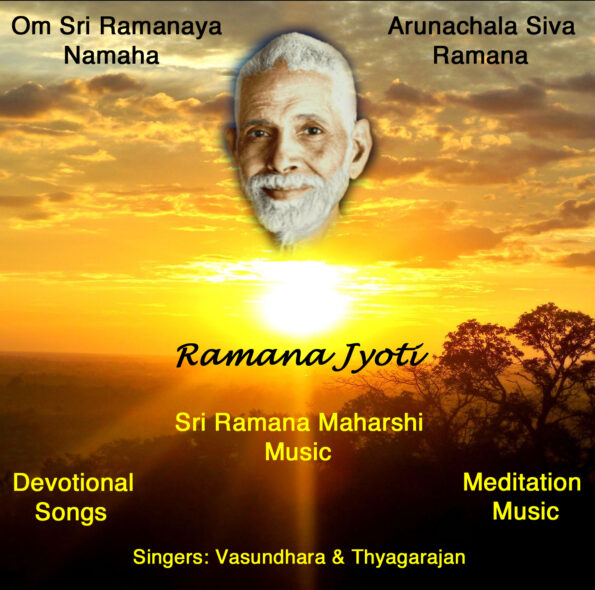
Ramana Jyoti – Devotional and Meditation Music Album

OM Shanti Shanti Shanti Hi

Lamp of Self Knowledge

Lamp of Self Knowledge

Splendor of the Self

Splendor of the Self


Ramana Jyoti

To download these songs free, please use this link:
Ramana Jyoti Songs – MP3 downloads

Ramana Jyoti – Devotional and Meditation Music

01 Arunachala Ramana Dedication

02 Arunachala Akshara Manamalai – Absorption

03 Arunachala Reverie

04 Arunachala Melody

05 Arunachala Trance

06 Arunachala Ramana Nee Vegamaai Vaaraai – Prayer

07 Arunachala Contemplation

08 Arunachala Meditation

09 Arunachala Surrender

Sri Ramana Maharshi – Evening Vedaparayana

Sri Ramanasramam – Evening Vedaparayana

You can use the Audio Player below to listen to the Playlist of all the tracks – either continuously, or just a specific track. Use the Play and Pause buttons as necessary. You can also listen to Individual Audio Tracks shown after the Playlist.

PLAYLIST:


  • Track 01 – Sri Rudram – Namakam by Ramanasramam
  • Track 02 – Sri Rudram – Chamakam by Ramanasramam
  • Track 03 – Purusha Suktam by Ramanasramam
  • Track 04 – Narayana Suktam by Ramanasramam
  • Track 05 – Durga Suktam by Ramanasramam
  • Track 06 – Taittiriya Aranyaka by Ramanasramam
  • Track 07 – Upadesa Saram by Ramanasramam
  • Track 08 – Na Karmana by Ramanasramam

Individual Audio Tracks:

Track 01 – Sri Rudram – Namakam

Track 02 – Sri Rudram – Chamakam

Track 03 – Purusha Suktam

Track 04 – Narayana Suktam

Track 05 – Durga Suktam

Track 06 – Taittiriya Aranyaka

Track 07 Upadesa Saram

Track 08 Na Karmana

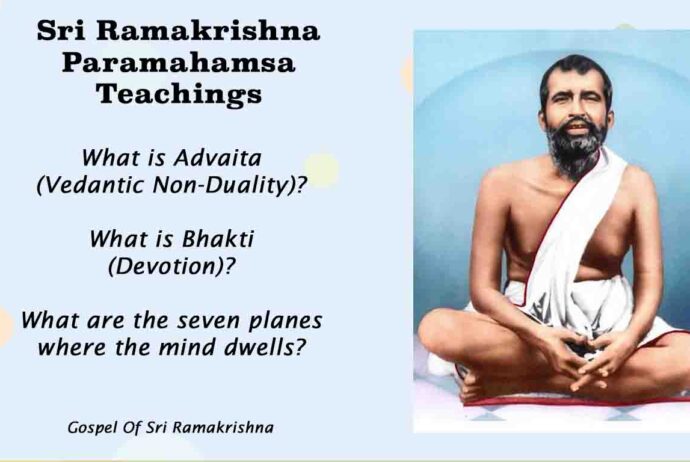
What are Advaita (Non-Duality), Bhakti (Devotion) & 7 planes of mind? – Ramakrishna

What are Advaita (Non-Duality), Bhakti (Devotion) & 7 planes of mind? – Ramakrishna


Ramakrishna Paramahamsa Teachings

What are Advaita (Non-Duality), Bhakti (Devotion) & 7 planes of mind?

In the light of Vedantic reasoning, Brahman, the Supreme Reality has no attributes. The real nature of Brahman cannot be described. But so long as your individuality is real, the world also is real, and equally real are the different forms of God and the feeling that God is a Person. 

Vedantic Non-dualism 

The forms and aspects of God disappear when one discriminates in accordance with the Vedanta philosophy. The ultimate conclusion of such discrimination is that Brahman alone is real and this world of names and forms illusory. It is possible for a man to see the forms of God, or to think of Him as a Person, only so long as he is conscious that he is a devotee. From the standpoint of discrimination this ‘ego of a devotee’ keeps him a little away from God. 

Do you know why images of Krishna or Kāli are three and a half cubits high? Because of distance. Again, on account of distance the sun appears to be small. But if you go near it you will find the sun so big that you won’t be able to comprehend it. Why have images of Krishna and Kāli a dark-blue colour? That too is on account of distance, like the water of a lake, which appears green, blue, or black from a distance. Go near, take the water in the palm of your hand, and you will find that it has no colour. The sky also appears blue from a distance. Go near and you will see that it has no colour at all. 

Therefore I say that, in the light of Vedantic reasoning, Brahman, the Supreme Reality has no attributes. The real nature of Brahman cannot be described. But so long as your individuality is real, the world also is real, and equally real are the different forms of God and the feeling that God is a Person. 

If you are a devotee, Yours is the path of bhakti, devotion. That is very good; it is an easy path. Who can fully know the infinite God? and what need is there of knowing the Infinite? Having attained this rare human birth, my supreme need is to develop love for the Lotus Feet of God. 

If a jug of water is enough to remove my thirst, why should I measure the quantity of water in a lake? If I become drunk on even half a bottle of wine, what is the use of my calculating the quantity of liquor in the tavern? Similarly, with devotion, What need is there of knowing the Infinite? 

The various states of mind of the Brahma jnani are described in the Vedas. The path of knowledge is extremely difficult. One cannot obtain jnāna if one has the least trace of worldliness and the slightest attachment to ‘carnal passions and money’. This is not the path for the Kaliyuga. 

Seven planes of the mind 

The Vedas speak of seven planes where the mind dwells. 

When the mind is immersed in worldliness it dwells in the three lower planes- at the naval, the organ of generation, and the organ of evacuation. In that state the mind loses all its higher visions-it broods only on ‘carnal passions and money’. 

The fourth plane of the mind is at the heart. When the mind dwells there, one has the first glimpse of spiritual consciousness. One sees light all around. Such a man, perceiving the divine light, becomes speechless with wonder and says: ‘Ah! What is this? What is this?’ His mind does not go downward to the objects of the world. 

The fifth plane of the mind is at the throat. When the mind reaches this, the aspirant becomes free from all ignorance and illusion. He does not enjoy talking or hearing about anything but God. If people talk about worldly things, he leaves the place at once. 

The sixth plane is at the forehead. When the mind reaches it, the aspirant sees the form of God day and night. But even then a little trace of ego remains. At the sight of that incomparable beauty of God’s form, one becomes intoxicated and rushes forth to touch and embrace it. But one doesn’t succeed. It is like the light inside a lantern. One feels as if one could touch the light, but one cannot on account of the pane of glass. 

In the top of the head is the seventh plane. When the mind rises there, one goes into samādhi. Then the Brahma jnani directly perceives Brahman. But in that state his body does not last many days. He remains unconscious of the outer world. If milk is poured into his mouth, it runs out. Dwelling on this plane of consciousness, he gives up his body in twenty-one days. That is the condition of the Brahmajnani. But yours is the path of devotion. That is a very good and easy path. 

In the light of Vedantic reasoning, Brahman, the Supreme Reality has no attributes. The real nature of Brahman cannot be described. But so long as your individuality is real, the world also is real, and equally real are the different forms of God and the feeling that God is a Person.